

What a Flat Marine Tarpaulin Does and Does Not Do
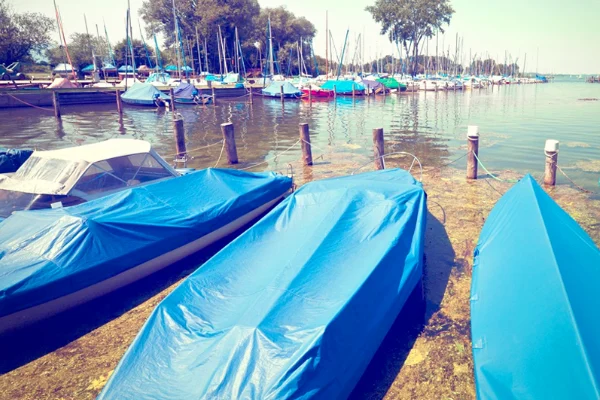
Flat covers are good at covering irregular objects in bulk. A hauled-out hull, a stack of masts and rigging, a pontoon run, a yard full of outboard motors — a flat tarpaulin covers all of these with a single sheet and minimal fitting.
GOOD AT
Bulk Coverage
Irregular objects, yard stacks, pontoon runs
NEEDS HELP
Wind Fixing
Eyelets, rope and ballast; no elastic hem
Right for Seasonal Storage, Wrong for Weekly Handling
A flat cover will not stay put in wind without help. It has no elastic hem, no hull-specific pattern, and no shaped corners. It relies on eyelets, rope and ballast, which means it needs more fixing points and more attention at the edges than a tailored cover. In practice, a flat cover is the right product for seasonal storage and yard protection, where the cover is fitted once and left. It is the wrong product for a cover that has to be removed and refitted weekly, or for a hull where the cover must shed water without ponding. For those jobs, a fitted cover is worth the extra cost.
PE or PVC for Coastal Duty?
Choose by salt exposure, abrasion and replacement cycle.
SEASONAL STORAGE
60–300 GSM
PE Tarpaulin
PE tarpaulin is the lower-cost option and perfectly adequate for seasonal storage in a moderate climate. It is light, waterproof through its LDPE lamination, and available from 60 to 300 GSM. For a cover that goes on in autumn and comes off in spring, it does the job.
- Weight & Cost
- Light to handle; lower cost per square metre.
- Waterproofing
- Waterproof through LDPE lamination on both sides.
- Best For
- Seasonal storage in a moderate climate.
- Limit
- Degrades faster under continuous coastal UV.
SALT, ABRASION & MULTI-YEAR USE
450 GSM+
PVC Tarpaulin
PVC-coated fabric is the better answer where salt, abrasion or a multi-year service life matter. It resists abrasion far better, it heat-welds rather than relying on stitching, and it holds up to sustained UV for longer.
- Weight & Cost
- Heavier to handle; higher initial material cost.
- Abrasion Resistance
- Resists abrasion far better than PE.
- Best For
- Salt exposure, abrasion and multi-year service life.
- Limit
- Over-specified for a single season of moderate storage.
Match the material to the duty. A light PE cover in full coastal sun is a one-season product. If a yard is replacing cheap covers annually, the arithmetic usually favours PVC from the start. Our PE vs PVC comparison sets out the trade-off.
Read the Full PE vs PVC ComparisonWhat “Marine Grade” Actually Means
It means nothing. There is no marine certification for tarpaulin, no standard behind the phrase, and no authority that issues it. Any supplier can print “marine grade” on a label.
Salt Spray Resistance
ASTM B117, quoted with the exposure duration in hours. 96 hours and 2,000 hours are both real figures; the number is what matters, not the word “marine”.
UV Ageing
ISO 4892-2 or ASTM G154 accelerated weathering, which predicts how the coating survives sun. Ask for the method and the exposure duration.
Mildew Resistance
Mildew resistance matters more than either salt spray or UV in humid coastal storage. Ask for the treatment and the test behind it.
Ask for the Test
When you compare suppliers, ask for the test, the method and the exposure duration. A supplier who answers “ASTM B117, 96 hours” is telling you something you can check against your own conditions.
Specify the tests, not the phrase. A supplier who answers “marine grade” is not giving you anything you can check. Share your coastal conditions and we will quote the test results for the grade you are considering.
Eyelets & Hem FinishingVentilation, Condensation and Mould
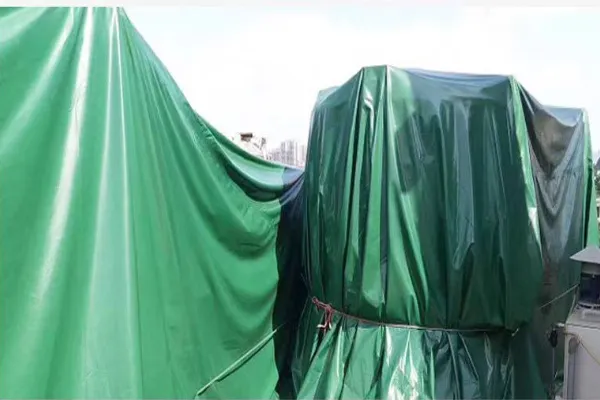
This is where a cheap cover costs more than it saves, and almost nobody talks about it. A waterproof cover over a stored boat traps moisture underneath it. Warm days draw water out of the hull, deck fittings and any damp gear; cool nights condense it against the inside of the cover. The result is mould on upholstery, staining on gelcoat, and in bad cases blistering below the waterline. An impermeable cover makes this worse, not better, unless air can move.
Dry Before Covering
Step 01Leave the hull dry before covering. Covering a wet boat seals the moisture in. This is the single most effective step and costs nothing.
Tent the Cover
Step 02Tent the cover rather than laying it flat. A ridge line above the gunwale lets air move and stops water ponding in the middle.
Aire Periodically
Step 03Aire the cover periodically. Even in winter storage, lifting the cover on a dry day resets the humidity underneath.
For yards covering many boats, a lighter cover with designed air movement usually outperforms a heavier impermeable one over a full winter.
Specify ventilation, not just waterproofing. Share your storage type, climate and how long the cover stays on. We will recommend a cover weight and fixing detail that lets air move.
Explore Special TreatmentsOrdering Covers for a Yard
Dimensions cut to your coverage areas rather than standard sheet sizes. Edge reinforcement with rope-reinforced hems and corner patches, which is where covers fail first.
-
Dimensions & Eyelets
Cut to your coverage areas. Eyelet spacing suited to the span and the wind exposure on your site.
-
Edge Reinforcement
Rope-reinforced hems and corner patches, which is where covers fail first under wind load.
-
Colour & Packing
Colour for yard identification or brand consistency. Packing suited to storage in a yard rather than retail shelves.
- Custom Dimensions
- Eyelet Spacing
- Rope-Reinforced Hems
- Corner Patches
Batch test reports reference tensile, adhesion and UV performance. BV or SGS inspection is available on request. Ask for the certificate for the grade you are being quoted, not for the product family.
Owned Production. Verifiable Capacity.
See the facilities behind your order.
- Production Bases
- 2
- Factory Area
- ~120,000 m²
- Main Lines
- 4
- Finishing Lines
- 6
- Monthly Output
- ~2,000 metric tons
CUSTOMER FEEDBACK
What Our Customers Say
★★★★★
“We cover a yard of hauled-out hulls and outboard stacks. The flat covers go on once in autumn and stay put through winter gales with rope-reinforced hems.”
★★★★★
“The PVC-coated covers handle salt spray and abrasion on our pontoon runs. After two coastal seasons they still have no pinholes or seam failures.”
★★★★★
“They told us honestly that a flat cover is not a fitted hull cover. That saved us ordering the wrong product, and the flat covers suit our dry-stack protection perfectly.”
★★★★★
“The batch test report quoted ASTM B117 salt spray hours and the UV method, not just the phrase ‘marine grade’. That is what we could check against our own conditions.”
★★★★★
“We ordered covers cut to our coverage areas rather than standard sheet sizes. Eyelet spacing was set for our wind exposure, and the covers have not lifted once.”
★★★★★
“The advice on tenting the cover and leaving the hull dry before covering solved our mould problem. Ventilation mattered more than a heavier cover.”
★★★★★
“Loading plans and documents were organised from the first order. Having one contact for packing details and shipping simplified our import process.”
★★★★★
“The cold-flex PVC stayed workable through a hard winter instead of cracking at the fold. That grade was the right call for our Northern European yard.”
★★★★★
“Colour matching for yard identification and roll width options were handled clearly. The sample process helped us finalise the specification for our cover range.”
Swipe or drag to explore
01 / 09
FAQ
Frequently Asked
Frequently Asked
Questions About
Marine & Boat Covers
Find answers about boat storage, marine grade, mould prevention, coastal material choice and fitted covers.
Have Another Question?Share your coverage areas, storage type and climate with our export team.
Can I use a PE tarpaulin as a boat cover?
Yes, for seasonal storage of a hauled-out boat, provided it is UV-stabilised and heavy enough to handle wind. It is a flat cover, so it will not follow a hull contour, and it needs more fixing points than a fitted cover. In full coastal sun a light unstabilised cover will not last a season.
What does marine grade mean for tarpaulin?
Nothing formal. There is no marine certification for tarpaulin and no standard behind the term. What matters is a named test result: ASTM B117 for salt spray with the exposure duration stated, and ISO 4892-2 or ASTM G154 for UV ageing.
How do I stop a boat cover from moulding?
Ventilation, not waterproofing. Let the hull dry before covering, tent the cover above the gunwale so air can move underneath, and lift it on dry days through the winter. An impermeable cover laid flat on a damp boat will grow mould.
Is PVC or PE better for coastal use?
PVC-coated fabric resists salt, abrasion and UV better and lasts longer, at a higher cost per square metre. PE is adequate for a single storage season in a moderate climate. If you are replacing covers every year, PVC is usually cheaper over three seasons.
Do you make fitted boat covers?
No. We supply flat covers cut to your dimensions for storage, dock and yard use. A fitted hull cover requires pattern-cutting for a specific boat model, which is an upholstery business, not a tarpaulin factory. We will say so at the first enquiry.
BUILT TO YOUR SPECIFICATION
Discuss Your Marina or Yard Requirements
One thing is worth repeating, because it is the reason this page is short: we sell flat covers, and a flat cover is not a fitted boat cover. If that is what you need, say so and we will tell you rather than quote you. If you are covering a yard, a dry-stack area or a storage fleet, send us four things and we will come back with a specification and a cost per cover.
START YOUR ENQUIRY
Discuss Marine Use
Request a Free Sample
Send four details: coverage areas and dimensions, how the covers will be used, climate and wind exposure on site, and destination port. We reply within one working day.