
Mesh Tarp Specification: Weave, Weight and Eyelets
A mesh tarp, also sold as a mesh tarpaulin, is a woven cover with open gaps between the warp and weft yarns, so air, light and water pass through it. That one property explains most of…
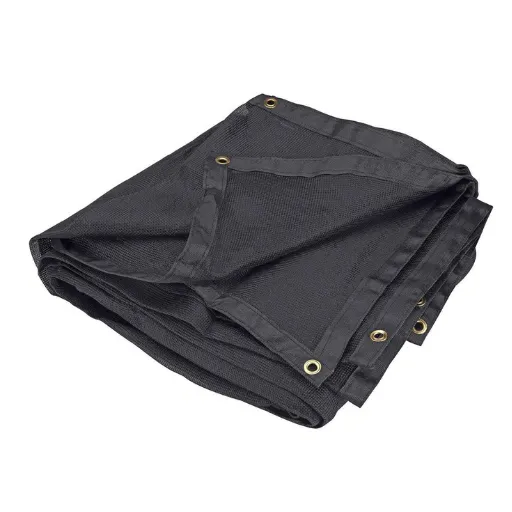
A mesh tarp, also sold as a mesh tarpaulin, is a woven cover with open gaps between the warp and weft yarns, so air, light and water pass through it. That one property explains most of what mesh is good for, and most of the ways buyers get it wrong. Two panels can both be sold as “heavy duty mesh” and still differ in yarn size, thread count, weight, openness and UV package. Price means nothing until those numbers are fixed.
This guide covers the five numbers that set a mesh tarp specification, the test methods behind them, and the jobs where mesh is the wrong material.
Key Takeaways
- A mesh tarp is specified by five numbers: thread count, GSM, openness or shade percentage, eyelet spacing and UV treatment. They don’t convert into one another.
- Woven mesh and knitted shade cloth are different products. A “70% shade” label describes measured light blockage, not a weave.
- TONGYUAN finishing runs eyelets from 30 cm apart in high wind to 1 m in sheltered use, in aluminium, brass or 304/316 stainless (company specification).
- Mesh is not waterproof, not a vapour barrier and not fall arrest. Dry cargo and weatherproof enclosures need a coated solid tarp.
- Ask for the test method and the batch report, not just a headline figure: ASTM D3776 for mass, D5034 for grab tensile, D2261 for tear, G154 for weathering.
What Is a Mesh Tarp?
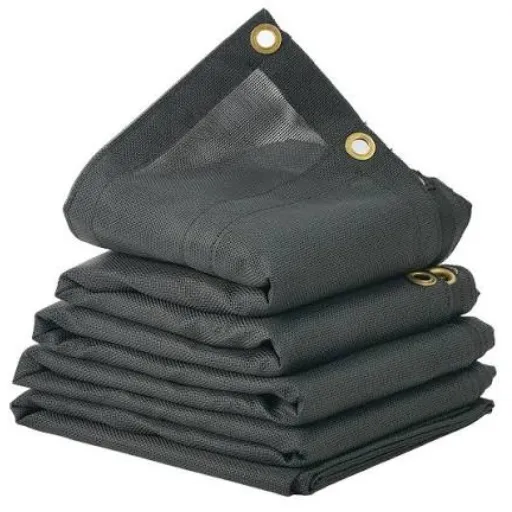
A woven mesh tarp is made on a loom from high-density polyethylene yarns, interlaced at right angles. The gaps between the yarns are part of the structure, not holes punched after the fact. That separates mesh from perforated film, where holes are cut into a solid sheet, and from a coated solid tarp, where a woven base is sealed with polyethylene on both sides until no gap remains.
The open grid changes how the panel behaves in wind. A solid tarp of the same weight catches the full wind load and acts as a sail. A mesh panel lets a large share of the air through, so the load on the fixings and on the structure behind it is lower. That is why mesh appears on scaffolding, fences, truck loads and shade structures, and why a solid cover in the same place needs heavier ties and a stronger frame.
What mesh does not do matters just as much. It isn’t waterproof. It sheds some rain at a shallow angle, then passes water through the openings once the panel is saturated or the rain is driven.
It isn’t a vapour barrier, so it won’t keep baleage or hygroscopic cargo dry. It isn’t a fall-arrest net, and it isn’t a rated horticultural shade cloth. Each of those jobs has a different product behind it. If your job needs a solid cover, start with the rather than forcing mesh into the application.
Woven Mesh vs Knitted Shade Cloth: What the Label Hides
Retail listings use “mesh tarp”, “shade mesh” and “shade cloth” almost interchangeably. They are not the same material, and the label rarely says which one you are buying.
Woven mesh has two sets of yarns crossing at right angles. The grid is stable, the panel resists stretching along the yarn direction, and the edge frays when cut unless it is hemmed or welded. It is rated by thread count and GSM.
Knitted shade cloth is built from interlocking loops. It stretches and conforms, has no straight grid, and is rated by shade percentage, the share of visible light it blocks.
Shade percentage is a measured optical property of the finished fabric. It is not a thread count in disguise, and it cannot be calculated from one. A 6×6 weave in one yarn can block a different share of light than a 6×6 weave in another, because yarn width, colour and finish all change the result. shows that woven and knitted constructions differ in airflow resistance and radiation transmission even at a similar nominal shading level, which is why the construction belongs on the specification next to the shade figure.
| Property | Woven mesh tarp | Knitted shade cloth |
|---|---|---|
| Construction | Interlaced warp and weft | Interlocked loops |
| Rated by | Thread count, GSM | Shade percentage |
| Strength | Higher along yarn direction; tears stop at a yarn | Lower; stretches under load |
| Edge | Must be hemmed or welded | Usually sewn or taped |
| Typical use | Debris, scaffold, cargo, fence, windbreak | Horticulture, privacy, patio shade |
| Water | Passes through | Passes through |
Consider a distributor who quoted a “70% shade mesh” for a playground. The figure came from a yarn datasheet for a different construction. When the panel arrived, the measured light transmission told a different story, and the reorder cost more than the margin on the first order. A measured figure and a named test method would have caught it before the quote went out.
The Five Numbers That Set a Mesh Tarp Specification
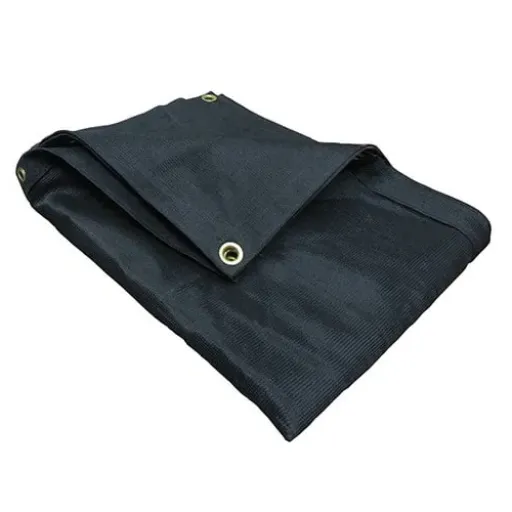
A purchase order that says only “mesh tarp, heavy duty, 20 x 30 ft” leaves the supplier free to choose every number that controls performance. Fix these five, or accept whatever the cheapest compliant-looking panel happens to be.
1. Thread count and yarn size
Thread count is written warp x weft: the number of yarns per inch in each direction. Woven polyethylene mesh on the market commonly runs from about 6×6 to 14×14. A higher count gives a denser, less open grid, but it does not by itself give a stronger panel. A 10×10 weave in a thin yarn can be weaker than a 6×6 weave in a heavy tape.
Yarn size is quoted as denier, or as tape width and thickness. Specify it, or specify the finished properties you need and let the supplier propose the construction. Thread count alone tells you how the grid looks, not how much load it carries. When a buyer asks for a heavy duty mesh tarp, the first question should be which of the two changed.
2. GSM and base weight
GSM is grams per square metre of the finished fabric. It is the quickest way to compare base weight and the least sufficient on its own. Two 170 GSM meshes can differ in yarn size, weave and coating, and therefore in strength, openness and handle.
Use GSM as a screen, then confirm the construction behind it. Our explains how weight maps to use for solid and coated fabrics.
These market bands are selection references, not product guarantees: light debris and dust control around 45-100 GSM; general debris, fence and shade around 120-170 GSM; heavy cargo, dump trailer and demanding debris around 180-230 GSM. TONGYUAN’s published PE range is 60-300 GSM, and a mesh construction within that range is confirmed per order rather than assumed from the range.
3. Openness and shade percentage
Openness is the share of the panel area that is open. Shade percentage is the share of light blocked. They move together but are not identical, because yarn width, colour and finish change how much light the solid part blocks.
For a mesh tarp for shade, the measured figure and the method matter more than the weave label. Ask the supplier to state both. If the answer is a thread count plus an estimate, treat the shade figure as unverified.
For horticulture, buy a product rated for the crop and the climate. A general cargo mesh with a shade number added at the quotation stage isn’t the same product, and the difference shows up in the first hot week.
4. Eyelet spacing and edge construction
Eyelets and hems carry the load. Our specification sets eyelet centres at least 15 mm inside the edge, with spacing from 30 cm to 1 m depending on exposure: 30-45 cm for high wind and heavy duty, 45-60 cm for general duty, and up to 1 m for sheltered or light duty. Eyelet material follows the environment: aluminium as standard, brass where corrosion matters, and 304 or 316 stainless for coastal and chemical exposure.
Hems can be single folded, double folded, welded, sewn, rope-reinforced or webbing-reinforced. Our finishing team puts roughly 80% of field failures at the eyelet and hem rather than the panel, which is why the edge specification deserves more attention than the logo. If the panel will be tensioned, rope-reinforced hems and closer eyelets do more for service life than another 20 GSM in the middle of the sheet.
5. UV treatment
UV stabilisation is an additive package in the polymer, set when the yarn is extruded or the fabric is made. It isn’t a coating applied afterwards, and it can’t be added to finished stock. Ask for the UV package in hours under a named test, usually ASTM G154 accelerated weathering, and ask whether the figure applies to the yarn or the finished panel. Our page explains how we specify and test UV and fire-retardant packages.
Colour matters too. Dark colours absorb more heat and can run hotter under sun, which affects both the polymer and anything stored under the cover. A UV claim without a test method and a figure is a marketing line, not a specification.
Have the five numbers? A physical sample settles questions that a datasheet cannot. with your thread count, GSM band and panel size.
Matching Mesh Tarps to the Job
The application sets the weight band, the openness and the edge detail. Start with the job, then choose the numbers.
| Application | Typical weight band | Openness note | Eyelet spacing | Edge |
|---|---|---|---|---|
| Shade and privacy screen | 120-170 GSM | Denser weave for privacy; shade figure measured | 45-60 cm | Rope-reinforced hem |
| Scaffold debris net | 120-170 GSM | Open enough to pass air, tight enough to contain debris | 30-45 cm | Reinforced, tied at every eyelet |
| Temporary enclosure | 160-230 GSM | Moderate openness; FR may be required | 30-45 cm | Webbing or rope-reinforced |
| Truck and dump trailer cover | 180-230 GSM | Heavy yarn, abrasion resistance | 30-45 cm | Double-fold or rope-reinforced |
| Fence screen | 120-170 GSM | Dense weave for wind and privacy | 45-60 cm | Sewn or welded hem |
| Agricultural windbreak | 120-170 GSM | Open enough to reduce wind, not block it | 45-60 cm | Rope-reinforced |
A truck mesh tarp for a dump trailer takes the heaviest band in this table, because the panel rubs against the load and the frame as the body tips.
Consider a site manager who covered a skip with a light dust sheet because it was already in the yard. The first gust pulled the eyelets out and wrapped the panel around the scaffold. A 170 GSM debris net, tied at 30-45 cm centres, would have cost more per square metre and lasted the job.
Wind load, fixings and scaffold compliance
Mesh lowers wind load compared with a solid sheet, but it doesn’t remove it. The remaining load goes through the eyelets, the ties and the structure behind the panel.
For scaffold netting and sheeting in the UK, sets the requirements. Ties go at every eyelet, with a minimum width and breaking strain (4.8 mm and 22 kg are the figures commonly quoted), a maximum tie spacing, defined overlaps, and a recognised fire certificate for the product. Check the current edition of the standard and match the certificate to the actual product, not to the fabric family.
For jobs that combine mesh with solid sheeting, our page covers the wider specification.
Where mesh is the wrong choice
- Dry cargo and weatherproof enclosures. Use a coated PE or PVC tarp. Mesh passes water.
- Baleage and silage. The cover has to be airtight. Mesh is not.
- Fall arrest. Mesh is not a fall-arrest net and must not be used as one.
- Horticulture with a specified shade percentage. Use a rated shade cloth, knitted or woven, with a measured figure.
- Privacy at close range. A high-openness mesh hides a site from a distance, not a window from the pavement.
Test Methods and What to Ask For
A test method turns a claim into a number another lab can reproduce. These are the ones to put on the purchase order.
| Property | Test method | What the number tells you |
|---|---|---|
| Mass per unit area | Confirms the GSM of the finished fabric | |
| Grab tensile strength | Strength in use, measured on a gripped specimen | |
| Tongue tear strength | ASTM D2261 | Resistance to a tear once it starts |
| Accelerated weathering | ASTM G154 | UV durability under a defined exposure cycle |
| Fire performance | NFPA 701, EN 13501-1 | Compliance for the destination market |
A typical value is not a batch result. Ask for the report for the lot you are buying, and check that the sample description matches the construction on the order. If the supplier can only offer a catalogue figure, treat it as a design guide and test the incoming lot.
One more number is easy to miss: cut size versus finished size. Hems and eyelets consume fabric, so a 20 x 30 ft cut panel delivers less than 20 x 30 ft of covered area once it is finished. State both dimensions on the order, and say which one the price refers to.
Where TONGYUAN Fits
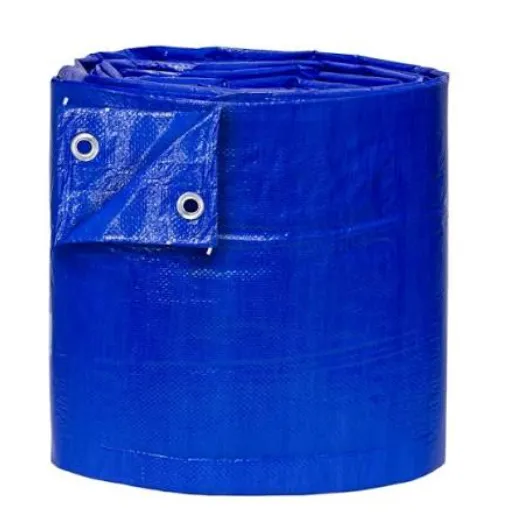
TONGYUAN has woven and coated HDPE tarpaulin since 2002, with in-house weaving and coating at two facilities in Qingdao and Shanghai. The published PE range is 60-300 GSM. Tensile strength runs at about 400 N/5cm at 120 GSM and toward 650 N/5cm at 180 GSM (company figures). We make eyelets, rope-reinforced hems, corner reinforcement, heat-welded seams and UV-stabilised fabric, and we confirm width, length, GSM and colour against the order.
For a custom mesh tarp, send the thread count or the openness you need, the GSM band, panel size, eyelet spacing, hem type, UV requirement and destination port. Our export desk will confirm in writing whether the construction is available for your order, with the weave, GSM band and test data, before you commit to a purchase order.
Two practical notes. PE minimum order is about 1,000 kg or one 20GP container, samples take 3-5 business days with freight at the buyer’s account, and production runs 15-25 days after confirmation. Batch test reports are available on request, and BV or SGS inspection can be arranged.
One boundary: knitted shade cloth is not a TONGYUAN product. If the project needs a rated shade percentage for horticulture, buy it as shade cloth, not as a mesh tarp with a shade number attached.
FAQ
What is a mesh tarp used for?
Mesh tarps cover jobs that need airflow: scaffold debris netting, fence screens, truck and dump trailer covers, temporary enclosures, shade and windbreaks. They contain material and cut wind load without sealing the surface.
Is a mesh tarp waterproof?
No. Mesh passes water through the open grid. It sheds some rain at a shallow angle, but it is not a waterproof cover and should not be used for dry cargo, baleage or weatherproof enclosures.
What is the difference between a mesh tarp and shade cloth?
A mesh tarp is woven and rated by thread count and GSM. Shade cloth is usually knitted and rated by shade percentage, a measured optical figure. A thread count can’t be converted into a shade percentage.
What GSM mesh tarp do I need?
As a selection guide: 45-100 GSM for light debris and dust, 120-170 GSM for general debris, fence and shade, and 180-230 GSM for heavy cargo and demanding debris. Confirm the weave and yarn size behind the GSM before ordering.
How far apart should eyelets be on a mesh tarp?
From 30 cm to 1 m depending on exposure. Use 30-45 cm for high wind and heavy duty, 45-60 cm for general duty, and up to 1 m only in sheltered or light duty. Eyelets should sit at least 15 mm inside the edge.
Can a mesh tarp be used as a scaffold cover or debris net?
Yes, if the product is specified for it. In the UK, TG27:25 sets tie strength and spacing, overlap and fire certification. Confirm the certificate matches the product and check the current edition of the standard.
Conclusion
A mesh tarp is not one product with one price. It is a set of five decisions: thread count and yarn size, GSM, openness or shade percentage, eyelet spacing and edge construction, and UV treatment. Fix those numbers and the quotes become comparable, the samples become checkable, and the panel does the job it was bought for.
If you are sourcing woven mesh, send the five numbers with your panel size and destination. We will confirm what we can produce, in writing, before you commit. You can for a quotation, or ask for a sample first if the weave needs a physical check.