
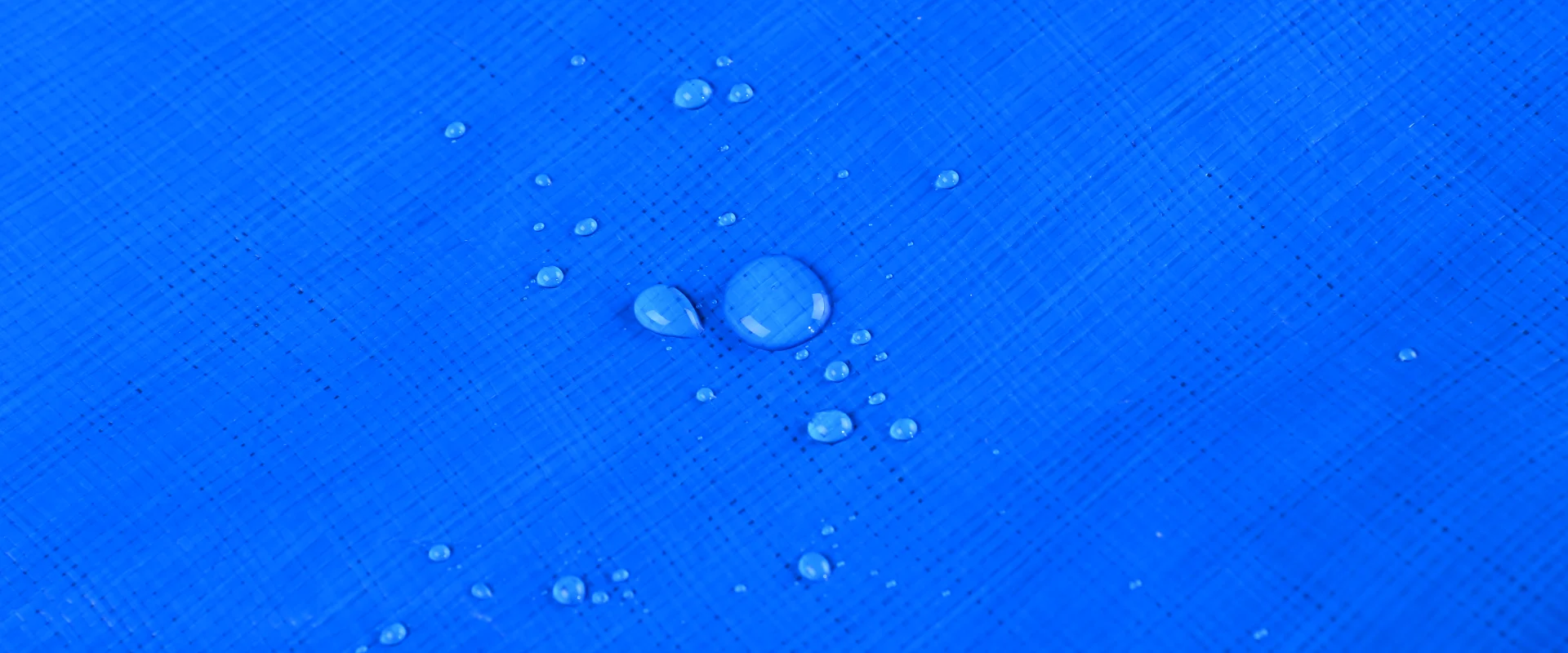
Why Finishing Decides Service Life
Fabric is uniform and predictable. It is woven, coated and tested in continuous runs, and its properties vary little from roll to roll. Finishing is the opposite. It is where the most manufacturing steps happen per square metre, where variation enters, and, critically, where load concentrates.
FABRIC PANEL
Uniform & Predictable
Woven, coated and tested in continuous runs
FINISHING
Variable & Load-Bearing
Most steps per square metre; load concentrates here
An Eyelet Is a Hole Surrounded by Material
The whole design question is how much material surrounds it, and how well the load is shared between one fixing point and the next. A cover that fails at the panel has usually been abused. A cover that fails at the eyelet has usually been under-specified. That distinction is what this page is about.
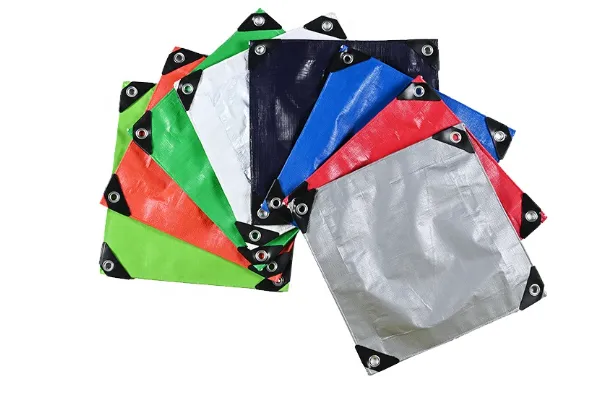
Eyelets: Material, Size and Spacing
How eyelet hardware and spacing decide whether the edge holds or pulls out.
| Specification | Value / Recommendation |
|---|---|
| ALU Aluminium eyelets | Standard and adequate for most duty |
| BRS Brass eyelets | Resists corrosion better than aluminium |
| SS Stainless steel 304 / 316 | For coastal, chemical or long-life use |
| Barrel length | Material thickness + 1.0–1.5 mm |
| Flange width | At least 3 × material thickness + rope diameter |
| Minimum edge offset | 15 mm or more (woven PVC, 0.6 mm and above) |
| Corner flange width | 10–12 mm or more |
| Spacing — high wind, heavy duty | 30–45 cm |
| Spacing — general duty | 45–60 cm |
| Spacing — sheltered, light duty | Up to 1 m |
Closer Spacing Is Not Automatically Stronger
An eyelet set too close to the edge has too little material around it to carry load, so it pulls out rather than holding. Fifteen millimetres is the floor, not a target. More holes in marginal material can weaken the edge rather than reinforce it. Uneven tension across too many fixings, or anchors that are fitted but never actually loaded, both make early failure more likely rather than less. Spacing helps when the hem is strong enough to share the load and the anchors are genuinely used. It does not compensate for a weak hem.
Tarpaulin Hem Types and When Each Is Used
The hem is not decoration. It is the load path from the eyelet into the fabric, and it decides how much material carries the pull.
FOLDED EDGE OPTIONS
Light to general duty
Single Fold & Double Fold
The simplest hem constructions. A single fold suits light covers under low load. A double fold puts more material around each eyelet and is the general-duty default.
- Construction
- Edge folded once (single) or twice (double), welded or sewn.
- Material at Eyelet
- Single: minimal. Double: more material around each eyelet.
- Best For
- Light covers, low load; double fold for general duty.
- Limit
- Neither distributes load along the edge under wind.
LOAD-DISTRIBUTING EDGES
Wind load
Rope & Webbing Reinforced
A polypropylene rope or webbing strip is laid inside the folded hem before it is closed. Load is distributed along the whole edge instead of concentrating at each eyelet.
- Construction
- Rope or webbing laid inside the fold before closing.
- Load Path
- Spread along the edge rather than at each eyelet.
- Best For
- Covers under wind load; high-tension edges and repeated handling.
- Value
- Often the single most effective upgrade, more so than a higher GSM.
The rope-reinforced hem is the option most often asked for and most often misunderstood. The rope distributes load along the whole edge instead of concentrating it at each eyelet. On a cover that will be under sustained wind, it is usually the single most effective upgrade available, more so than moving up a GSM.
Corner Reinforcement
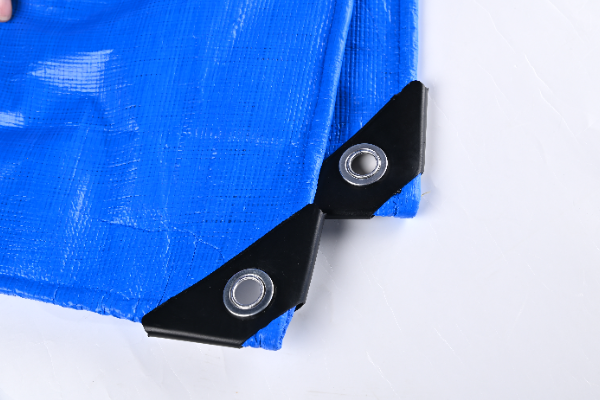
Corners fail first, and they fail diagonally. A corner takes load from two edges at once, so the resulting force enters the material along the diagonal.
Oversized Patch
A patch that extends well beyond the hardware, not one that just covers the eyelet. The force travels, so the reinforcement has to travel with it.
Diagonal Orientation
Patch orientation following the diagonal, not the edge. The load enters along the diagonal, so the reinforcement must follow the same path.
Cross-Layered Webbing
Cross-layered webbing on high-load corners. The webbing spreads the diagonal force across the corner rather than concentrating it at the hardware.
The Right Hardware
Published third-party testing by eyelet manufacturers reports roughly 2.1× to 2.3× higher failure load when standard eyelets are replaced with 10 mm-flange grommets and serrated washers on the same fabric.
Specify the corner reinforcement. Share the tension, wind exposure and securing method. We will match the patch size, orientation, webbing and hardware to your cover.
Tolerances and Acceptance Criteria
A capability claim is only useful if it is a number the buyer can inspect against. A finishing specification should state, for each order, the hem width and construction, eyelet spacing and edge offset, eyelet material and sizing, corner patch dimensions, seam type and the tolerance on each.
Hem & Eyelets
Stated per orderHem width and construction, eyelet spacing centre to centre, eyelet edge offset from the finished edge, and eyelet material, inside diameter and barrel/flange sizing.
Corners & Seams
Stated per orderCorner patch dimensions and orientation, seam type and route (welded or sewn), and the tolerance on each of the above.
Benchmark
±5% allowanceThe CRS emergency field specification calls for one eyelet every 1.00 m with a ±5% allowance, and it is a useful benchmark to hold any supplier to.
Finished size is also worth agreeing up front, because hemming consumes material. Cut size and finished size differ, and the difference should be confirmed before mass production rather than measured on arrival.
Put the figures on the production drawing. Once agreed, they belong on the drawing rather than in an email. A drawing is a single document both sides can check against at inspection, and it is the reason a repeat order matches the first one.
Why Tarpaulins Fail at the Fixing Points
If you are replacing covers repeatedly, the failure mode tells you what to change. None of these is a fabric failure. Each points at the finishing, and each is fixable on the next order.
-
Eyelet Pulls Out
Load concentrated at too few points; edge reinforcement too narrow; wrong tie-down angle; one fixing taking most of the force.
-
Diagonal Tear at Corner
Combined load from two edges; insufficient patch area or wrong patch orientation. The corner takes load from two directions at once.
-
Edge Flaps & Crescent Cuts
Flapping: spacing too wide, cover oversized, anchor line too far from the edge. Crescent cut: hardware bearing, poor eyelet seating, flange too narrow.
- Eyelet Pull-Out
- Diagonal Corner Tear
- Edge Flapping
- Crescent Cut
If you have a failed cover, send it to us and we will tell you which of the four it is. BV or SGS inspection is available on request. Batch reports reference named methods and finishing tolerances.
Owned Production. Verifiable Capacity.
See the facilities behind your order.
- Production Bases
- 2
- Factory Area
- ~120,000 m²
- Main Lines
- 4
- Finishing Lines
- 6
- Monthly Output
- ~2,000 metric tons
CUSTOMER FEEDBACK
What Our Customers Say
★★★★★
“We kept replacing covers because eyelets were pulling out. Switching to rope-reinforced hems and 15 mm edge offset stopped it — the same fabric now lasts three seasons.”
★★★★★
“The corner patches on our construction covers follow the diagonal, not the edge. The diagonal tears we used to see at the corners have stopped completely.”
★★★★★
“They specified 30–45 cm eyelet spacing for our high-wind site instead of a generic number. Edge flapping between fixings is gone, and the covers sit flat.”
★★★★★
“Stainless steel eyelets for our coastal yard cost a little more, but the hardware no longer rusts out while the fabric is still good. Fewer replacements overall.”
★★★★★
“The finishing spec was written onto a production drawing with tolerances, not buried in email. Our repeat order matched the first one exactly at inspection.”
★★★★★
“We sent back a failed cover and they diagnosed it as an eyelet pull-out, not a fabric problem. The fix was reinforcement width and tie-down angle, and it worked.”
★★★★★
“Webbing-reinforced edges on our high-tension covers held up to repeated handling. The hem is still the strongest part of the cover after two seasons.”
★★★★★
“They quoted the eyelet barrel length and flange width as numbers, not as ‘standard’. That detail is why the grommets seat properly and do not crescent-cut.”
★★★★★
“Heat-welded seams and reinforced corners were confirmed on a sample before mass production. The finished covers matched the approved sample exactly.”
Swipe or drag to explore
01 / 09
FAQ
Frequently Asked
Frequently Asked
Questions About
Edges, Eyelets & Finishing
Find answers about eyelet spacing, tear causes, hem construction, edge offset and welded versus sewn hems.
Have Another Question?Share your application, exposure and securing method with our export team.
What is the standard eyelet spacing on a tarpaulin?
There is no single standard, because spacing follows the load. We specify 30–45 cm for high-wind and heavy-duty covers, 45–60 cm for general duty, and up to 1 m for sheltered or light-duty use. The right figure is whatever is written on the production drawing.
Why do tarpaulins tear at the eyelets?
Almost always because the load is concentrated at too few points, or because the edge reinforcement is too narrow to spread it. Eyelet spacing that is too wide for the wind exposure, a tie-down angle that pulls across the edge rather than along it, or a hem without rope reinforcement will all produce the same result.
What is a rope-reinforced hem?
A folded hem with a polypropylene rope laid inside it before the fold is closed and welded or sewn. The rope distributes load along the whole edge instead of concentrating it at each eyelet, which is the most common point of failure.
How far from the edge should eyelets be?
At least 15 mm from the finished edge on woven PVC of 0.6 mm or more. An eyelet set closer than that has too little material around it to carry load and will pull out rather than hold.
What is the difference between a welded and a sewn hem?
A welded hem fuses the coating itself, so the join does not depend on thread and does not become the first point of failure. It applies to PVC. A sewn hem uses stitching, which suits PE and applications where welding is unsuitable. They are not interchangeable between materials, and the choice follows the fabric.
BUILT TO YOUR SPECIFICATION
Specify Your Finishing
The finishing is a specification, not an adjective. “Reinforced edges” on a quotation tells you nothing you can inspect against. A hem width, an eyelet pitch, an edge offset and a corner patch dimension do. Send us either a production drawing or the fundamentals, and we will return a finishing specification for approval.
START YOUR ENQUIRY
Send Your Finishing Specification
Request a Free Sample
Send four details: cover dimensions and whether those are cut or finished size, application and wind exposure, load and tie-down method, and material and GSM. We will return a finishing specification for approval.