
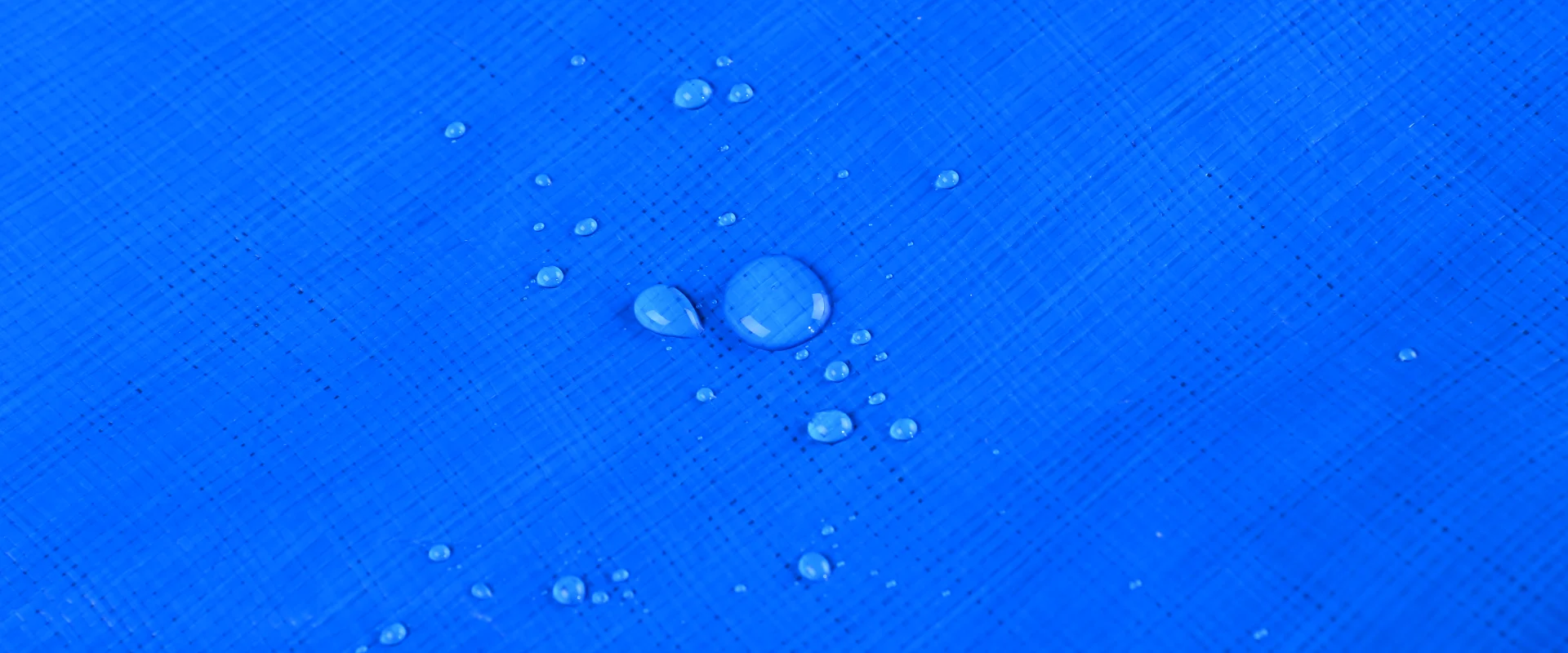
How Tarpaulin Is Made
Five steps, in order. The materials differ between PE and PVC, but the sequence does not. We run this sequence across two bases in Linyi and Jiangsu, and you can watch it live.
PE TARPAULIN
HDPE + LDPE
Woven HDPE tape laminated with LDPE on both sides
PVC TARPAULIN
Scrim + PVC
Polyester scrim knife-coated with PVC, then welded
The Sequence Is the Same for Both
Weave the base fabric, coat or laminate both sides, cure and fuse the coating, finish the fabric, then inspect against the specification.
How Tarpaulin Is Made
Five steps, in order. The materials differ; the sequence does not.
| Step | Process | Materials & Purpose |
|---|---|---|
| 01 | Weave the base fabric | HDPE tape for PE, polyester yarn for PVC. This is the structural layer that carries the load. |
| 02 | Coat or laminate both sides | LDPE film for PE, PVC plastisol for PVC. This is the waterproof, weather-resistant layer. |
| 03 | Cure and fuse the coating | Heat binds the coating to the fabric so it does not separate under tension or weather. |
| 04 | Finish the fabric | Hem, cut, eyelet and weld to specification. This is where the cover becomes a usable product. |
| 05 | Inspect against the specification | GSM, tensile strength, UV performance and dimensional accuracy. Documented in the batch test report. |
Watch It Run
We run this sequence across two bases in Linyi and Jiangsu. Book a video factory tour and watch the looms, coating line and welding machine run before you commit.
Knife Coating vs Lamination
Two ways to bond a coating to a fabric, and the difference matters to a buyer who has to defend a specification.
EVEN COATING WEIGHT
Our PVC
Knife Coating
Spreads liquid PVC and scrapes it to a controlled thickness. The result is an even coating weight across the roll — which is what keeps the quoted GSM honest from one end of a container to the other.
- Thickness Control
- Controlled by knife gap, blade geometry and line speed.
- Coating Evenness
- Even across the roll, roll to roll, batch to batch.
- Adhesion
- Fused into the scrim by gelation and oven fusion.
- Used For
- Truck covers, tents and architectural membrane.
FASTER, LESS EVEN
Our PE
Lamination
Presses a pre-formed molten film onto the fabric. It is faster and cheaper, but thickness control and adhesion are less even. Used for PE tarpaulin, where the service life is shorter and the tolerance is wider.
- Thickness Control
- Set by the pre-formed film, not scraped in place.
- Coating Evenness
- Less even than knife coating, by method.
- Adhesion
- Pressed and fused; adequate for seasonal covers.
- Used For
- PE tarpaulins for seasonal and general-purpose use.
Why we knife coat PVC. The applications that justify PVC — truck covers, tents, architectural membrane — are the ones where a GSM deviation of a few percent changes the service life. Ask for the batch test report and you will see the coating weight actually measured, not assumed.
Request a Batch Test ReportHDPE Weaving and LDPE Lamination
Four steps from HDPE resin to a finished, eyeleted PE cover.
HDPE Tape Extrusion & Drawing
HDPE resin is melted and extruded into a film, slit into tape, then stretched to align the polymer chains. The stretching is what gives the tape its strength — the yarn is drawn several times its original length before it is ready to weave.
The GSM of a finished PE tarpaulin starts here. The tape denier and the draw ratio set the base weight, and every grade from 60 to 300 GSM is built up from this stage.
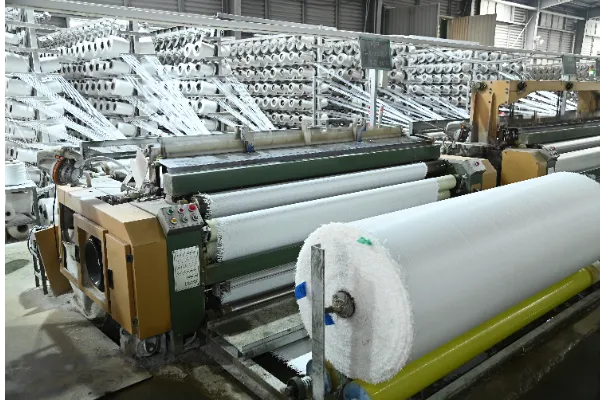
Weaving the Base Fabric
The drawn tape is woven into a base cloth on circular or rapier looms. Weave density determines tensile strength and tear resistance — a tighter weave carries more load per square metre.
This is the structural layer of the tarpaulin. The coating waterproofs it; the weave gives it the strength to hold an eyelet under load.
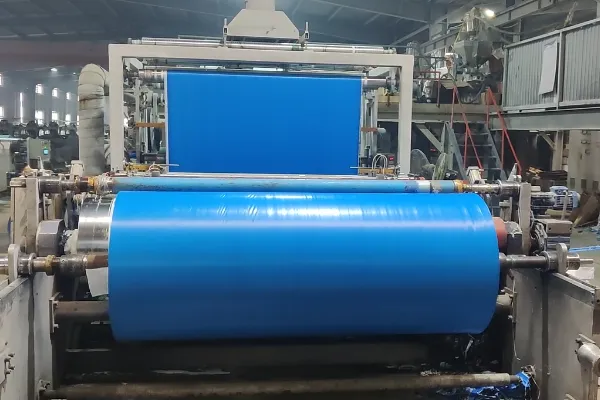
LDPE Coating on Both Sides
Molten LDPE is applied to both faces of the woven cloth and pressed into the fabric. The coating is what makes the cover waterproof and UV-resistant, and it locks the weave in place.
The same process is repeated on the reverse side. Coating both faces matters — a cover coated on one side only will fail where the uncoated weave is exposed to weather.
Finishing: Hemming, Eyelets and Cutting
The coated fabric is cut to size, hemmed, and finished with eyelets and rope-reinforced edges to the buyer’s specification.
This is where the cover becomes a usable product — and where most covers fail first, which is why the finishing detail is specified as carefully as the GSM.
See the finished PE range. Explore grades and applications, or request a sample of the grade you are considering.
PE Tarpaulin RangeScrim Weaving, Knife Coating and Welding
Five steps from polyester yarn to a welded, waterproof PVC panel. This is the sequence that defines our PVC output.
01 — Polyester Scrim Weaving
PVC tarpaulin starts with a high-tenacity polyester yarn woven into a scrim. The scrim is the load-bearing layer — typically 500D to 1300D yarn, chosen for tensile and tear strength rather than cost.
02 — PVC Plastisol Preparation
The PVC coating is mixed as a plastisol — PVC resin combined with plasticiser, stabiliser and pigment, plus the additives that deliver UV resistance, flame retardancy or anti-mildew performance. The formulation is matched to the grade and the treatment the buyer specifies.
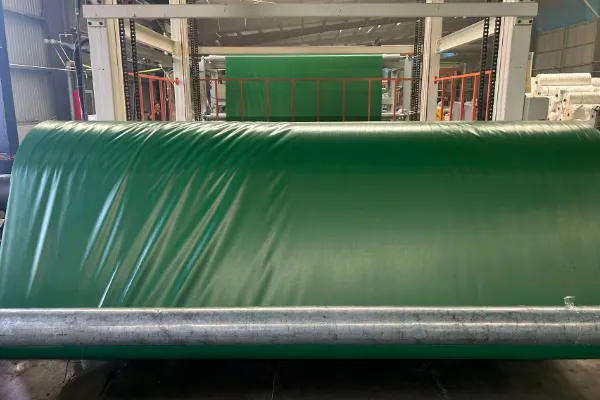
03 — Knife Coating
The scrim passes under a precision knife that spreads the liquid PVC and scrapes off the excess, leaving a controlled, even coating weight. Multiple passes build the coating to the target weight, and both faces are coated for heavy-duty grades. German knife-coating technology is used across the PVC line.
04 — Gelation, Fusion and Cooling
The coated fabric passes through an oven where the plastisol gels and fuses into a continuous PVC layer, then cools rapidly to set it. Temperature and dwell time are controlled to reach full fusion without yellowing or embrittling the material.
05 — High-Frequency Welding and Fabrication
PVC panels are joined by high-frequency welding, which fuses the PVC rather than stitching it. The seam becomes structurally continuous with the fabric, so it is not automatically the first point of failure.
See the finished PVC range. Explore grades and applications, or request a sample of the grade you are considering.
PVC Tarpaulin RangeWhat the Process Means for Your Order
The process is not a tour; it is the answer to the buyer’s real question — will the bulk order match the sample?
GSM Accuracy
Comes from knife coating and in-line weight checks, so a 650 GSM cover is 650 GSM when it arrives.
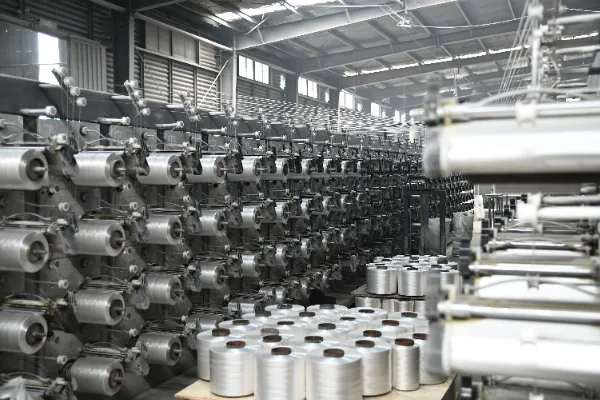
Seam Integrity
Comes from high-frequency welding, so the cover fails from wear, not from a stitched seam opening.
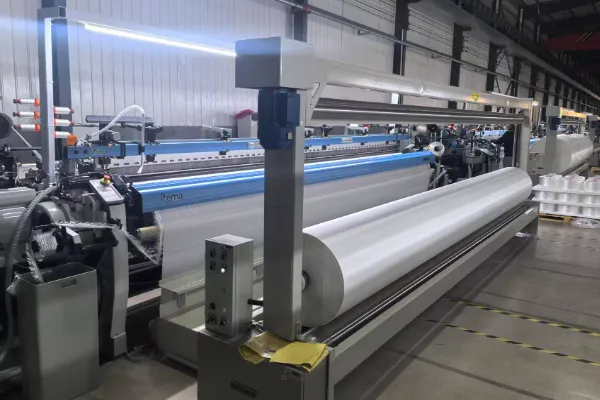
Batch Consistency
Comes from the 26-stage system running alongside production, documented in a batch test report.
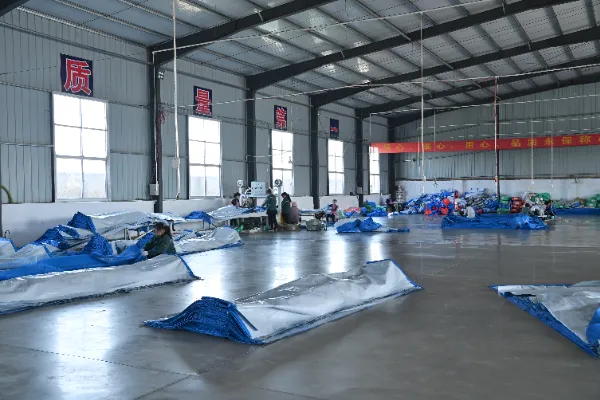
Open to Inspection
Approximately 120,000 m² of manufacturing area, four main production lines and six finishing lines. Book a visit or a live video walkthrough and watch it run before you commit.
Where Quality Control Fits Into the Process
Quality control is not a final inspection bolted onto the end. It runs alongside the process at each stage. A documented 26-stage quality control system spans raw material, in-line production and pre-shipment inspection.
-
Incoming Material
Raw material is checked before it reaches a line.
-
In-Line Production
GSM and dimensional accuracy are checked while the fabric is running.
-
Pre-Shipment Inspection
Tensile strength and UV performance are tested against the specification.
- GSM
- Tensile Strength
- UV Performance
- Dimensional Accuracy
Testing follows recognised methods such as ASTM D751 and ISO 13934-1. A batch test report is available on request for a specific grade.
Owned Production. Verifiable Capacity.
The point is consistency: the second container has to match the sample you approved.
- Production Bases
- 2
- Factory Area
- ~120,000 m²
- Main Lines
- 4
- Finishing Lines
- 6
- Monthly Output
- ~2,000 metric tons
CUSTOMER FEEDBACK
What Our Customers Say
★★★★★
“The batch test report confirmed GSM and tensile before we released the order to production. That documentation made our incoming inspection straightforward.”
★★★★★
“We watched the knife coating line run on a video walkthrough before placing the order. Seeing the process made the specification easy to defend internally.”
★★★★★
“High-frequency welded seams on the PVC covers were clean and continuous. The covers failed from wear eventually, not from a seam opening.”
★★★★★
“Coating weight was consistent from one end of the container to the other. The 650 GSM figure on the quote is what arrived.”
★★★★★
“Private-label packing followed the approved artwork. The rolls cut cleanly and the bales arrived retail-ready without extra handling.”
★★★★★
“The in-line GSM checks and dimensional accuracy gave us confidence in the roll widths. Our conversion process runs efficiently as a result.”
★★★★★
“Order details, packing and shipping documents were organized. Having one contact for process documentation simplified our import process.”
★★★★★
“The recommended grade suited our industrial curtain conversion. Roll width, core size and UV level were confirmed before production started.”
★★★★★
“Colour matching and roll length options were handled clearly. The sample process helped us finalise the specification for our wholesale roll range.”
Swipe or drag to explore
01 / 09
FAQ
Frequently Asked
Frequently Asked
Questions About
Tarpaulin Manufacturing
Find answers about how tarpaulin is manufactured, knife coating, woven vs coated fabric, seam joining and quality testing.
Have Another Question?Share your application and specifications with our export team.
How is tarpaulin manufactured?
A tarpaulin is made by weaving a base fabric, then coating or laminating both sides to make it waterproof. PE uses woven HDPE tape laminated with LDPE; PVC uses a polyester scrim coated with PVC. The fabric is then cured, finished and inspected.
What is knife coating?
Knife coating spreads liquid PVC over a polyester scrim and scrapes it to a controlled thickness with a precision blade. It produces an even coating weight, which is what keeps GSM consistent across a roll.
What is the difference between woven and coated tarpaulin?
Woven tarpaulin is a bare woven fabric with no waterproof layer. Coated tarpaulin adds a plastic coating on both sides — LDPE for PE, PVC for PVC — that makes it waterproof and weather-resistant. Almost all tarpaulins sold as waterproof are coated.
How are tarpaulin seams joined?
PVC tarpaulin is joined by high-frequency welding, which fuses the material into a continuous, waterproof seam. PE tarpaulin is typically hemmed and sewn, with reinforcement at the eyelets and corners.
How is tarpaulin quality tested during production?
Quality is checked in line and at pre-shipment — GSM, tensile strength, UV performance and dimensional accuracy against the specification. Testing follows recognised methods including ASTM D751 and ISO 13934-1, and a batch test report is available on request.
Can I see the process before I order?
Yes. We run the process across two bases in Linyi and Jiangsu, and you can watch it live — book a video factory tour and watch the looms, coating line and welding machine run before you commit.
SEEING THE PROCESS FOR YOURSELF
Watch the Process. Verify the Specification.
A specification you can verify is worth more than a claim you cannot. Book a video factory tour and watch the looms, the coating line and the welding machine run — or send us a specification and let the batch test report do the talking.
START YOUR ENQUIRY
Book a Video Factory Tour
Request a Batch Test Report
Factory tour · Process documentation · Batch test report