
Hay Tarps for Round Bales: Sizing, Storage and Moisture Control
Hay tarps for round bales are a rain cover, not a drying system. Use a UV-stabilised PE tarp sized to the stack, cover the top, leave the sides open, and only cover hay baled at 18%…
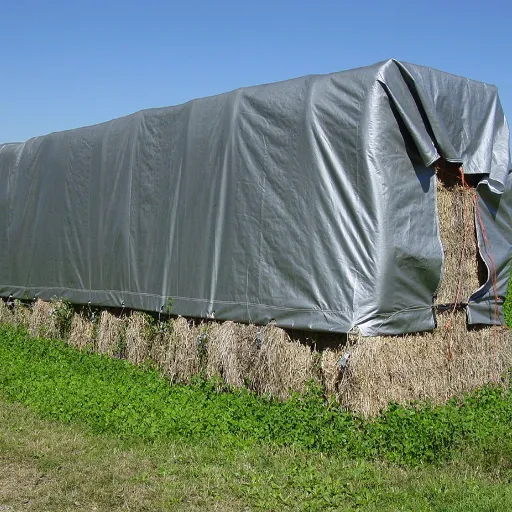
Hay tarps for round bales are a rain cover, not a drying system. Use a UV-stabilised PE tarp sized to the stack, cover the top, leave the sides open, and only cover hay baled at 18% moisture or below. Baleage at 50-60% moisture needs sealed film instead.
The stack that fails usually looks fine on top. The mould is in the middle, where no one looked until feeding started.
The decisions run in order: is the hay dry enough, what size fits the stack, PE or canvas, then how to stack and cover.
Key Takeaways
- Dry hay at 18% moisture or below can be covered. Baleage at 50-60% needs sealed silage film, not a hay tarp.
- Cover the top, leave the sides open and keep bales off the ground. A waterproof cover on a damp base traps moisture.
- Size the cover to the stack, not the bale count. Measure the path over it, add side drop and tuck-under, then confirm the cut size.
- PE at 150-250 GSM with UV stabilisation is the practical rain-cover default. Canvas at 12-18 oz/yd² is breathable but water-resistant, not waterproof.
- A tarp cannot dry wet hay. A heavier tarp does not fix a wet stack.
If you know the stack dimensions, and we will check the cover size before you price the job.
What Hay Tarps for Round Bales Have to Do
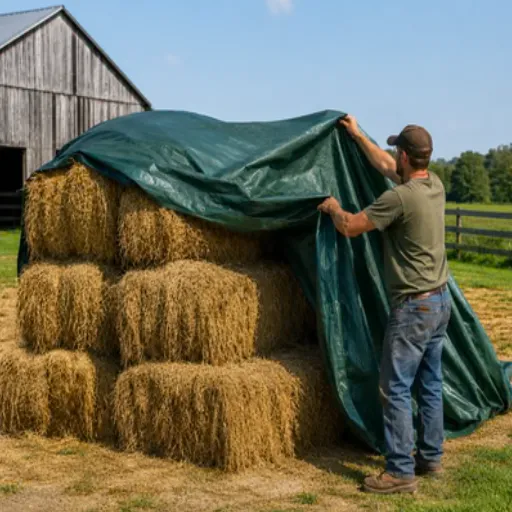
A round bale is a dry-looking shell around a core that still holds moisture. A cover has to keep new water out without sealing the old water in.
Three sources of water sit under a hay tarp, and they look similar when you open the stack.
Rain and meltwater gets in through a torn cover, an open seam, a gap at the edge or a low spot where it pools. This is the source a tarp is designed to stop.
Ground moisture wicks upward from soil or wet grass. The bottom row can be damp while the top is dry. Illinois Extension notes that a third of a 5.5 ft bale sits in the outer 6 inches, which is why a drained base matters.
Condensation forms when warm, moist air inside the stack meets the cooler underside of the cover and reaches its dew point. Droplets fall back onto the hay, and a sealed cover can make this worse.
The economics are not subtle. In the storage comparison published by , dry matter loss was about 5% in a shed, 7% for a tarp on a pad, 10% for an elevated stack and 23% for net-wrapped bales on the ground without a cover.
A Missouri cow-calf operation with 200 bales at 1,000 lb each has about 100 tons. Net wrap on the ground loses about 23 tons; a tarp on a drained pad loses about 7 tons. That is 16 tons, or $3,200 at an assumed $200 per ton.
Dry Hay vs Baleage: The Decision That Sets the Cover
The most expensive mistake in hay storage is treating dry hay and baleage as the same product.
gives the standard baling targets: about 20% moisture for small rectangular bales, 18% for large round bales and 17% for large rectangular bales. Baling wetter invites heating, mould and, in the worst case, spontaneous combustion. Dry hay still releases moisture after baling, so the stack needs to breathe.
Baleage is a fermentation system, not dry hay with a different cover. puts the target at 50-60% moisture and says bales need to be wrapped within 12 hours of baling as the outer limit. The wrap excludes oxygen so the forage ferments instead of rotting.
A standard hay tarp cannot do that job. It is not airtight, not a continuous wrap and does not create the anaerobic condition baleage needs. Use silage film, and keep the tarp for dry hay.
Sizing Hay Tarps for Round Bales
The right size is not the bale count multiplied by a catalogue figure. It is the path over the stack, plus the side drop and the material you tuck under.
Measure the stack’s width, length and height, plus the bale diameter. Round bales usually run 4-6 ft in diameter, so two stacks with the same bale count can need different covers.
For a flat-topped stack:
Cover width = top width + (side drop x 2) + (tuck-under x 2)
Cover length = top length + (end drop x 2) + (tuck-under x 2)
Use at least 2 ft of tuck-under per side, and 3 ft on exposed sites. For a pyramid or a row, the top is curved, so measure the actual path with a tape from ground to ground over the highest bale, then add the tuck-under.
| Stack arrangement, 4 x 5 bales | Base width | Approx. path over the stack | Add 2 ft tuck-under per side | Minimum cover width |
|---|---|---|---|---|
| Single row | 5 ft | about 8 ft | 4 ft | about 12 ft |
| Two rows touching | 10 ft | about 16 ft | 4 ft | about 20 ft |
| 3-2-1 pyramid | 15 ft | about 32-34 ft | 4 ft | about 36-38 ft |
Take a 3-2-1 pyramid of 4 x 5 bales, 10 bales long. The row is about 40 ft long, 15 ft wide and 13-14 ft high. The path across it is roughly 32-34 ft.
Add 2 ft of tuck-under each side and the cover needs about 36-38 ft of width. Add 2 ft of end drop each end and it needs about 44 ft of length. A 40 x 48 ft cover gives margin on both dimensions. A 30 x 50 or 33 x 48 cover is long enough but too narrow.
Common stock sizes include 25 x 48, 30 x 50, 33 x 48 and 40 x 48 ft. If your stack falls between sizes, go up rather than down. TONGYUAN cuts each round bale tarp to the finished size, so confirm whether a quoted size is cut or finished.
Need a cut size confirmed? and we will check the covering path.
Breathable or Waterproof Hay Tarps for Round Bales?
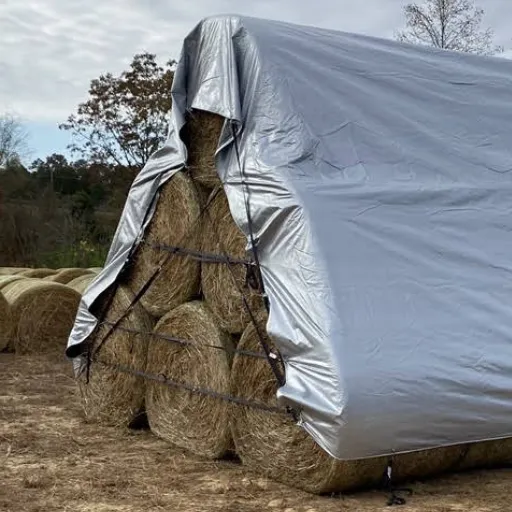
The useful answer depends on which risk is greater: rain reaching the bales, or moisture trapped under the cover.
PE tarpaulin is a woven HDPE base with LDPE coating on both sides. The coating makes the sheet waterproof and a vapour barrier. For dry hay in a rainy climate, keeping liquid water off the stack is the main job. TONGYUAN’s runs from 60 to 300 GSM, with UV stabiliser from 0.3% to 3% by grade and company-reported tensile strength from about 250 to 1,500 N/5cm.
Cotton canvas is woven and proofed with wax or paraffin. The proofing adds water resistance and weight but does not seal the weave, so vapour passes through. TONGYUAN’s runs from 12 to 18 oz/yd², roughly 410-610 GSM.
It is breathable and mildew-inhibited for export, but water-resistant only: standing water and unsealed seams soak through. Company-reported life is three to seven years.
| Your situation | Practical cover | Why |
|---|---|---|
| Dry hay, exposed site, rain is the main risk | PE 150-250 GSM, UV-stabilised, top cover with open sides | Keeps liquid water out; open sides let vapour escape |
| Dry hay, humid site, condensation is the main risk | Canvas 12-18 oz/yd², top cover with open sides | Breathable; water-resistant rather than waterproof |
| Short-term storage or a covered yard | PE 120-150 GSM | Lower cost and easier handling where rain exposure is limited |
| High wind, long life, repeated reuse | PE 200-300 GSM with rope-reinforced hem and closer eyelets | More strength and UV stabiliser; edge detail matters more than extra weight |
| Baleage or silage | Sealed silage film, not a hay tarp | Needs anaerobic conditions; a tarp cannot seal the bale |
The physics is covered in . For round bales, breathability helps vapour leave the hay. It does not dry wet hay or replace a drained base and open sides.
TONGYUAN does not make a purpose-built breathable hay tarp and does not publish a vapour transmission figure for its canvas. We supply a sealed PE cover or a breathable canvas cover and say which fits your risk. If you need tested MVTR and hydrostatic head, ask any supplier for the numbers. A breathable label without a figure is a marketing claim, not a specification.
GSM, UV and Finishing: The Specification
Once the fabric is settled, the specification decides how long the cover lasts and whether it stays on the stack.
TONGYUAN’s lists 120-150 GSM PE with a reinforced hem for hay and straw, and 150-250 GSM PE or PVC for silage and bunker covers. The recommends 150-250 GSM PE with UV for hay, silage and grain. For round bales, use 120-150 GSM for short-term or covered storage, 150-250 GSM for exposed stacks that must last a season or two, and 200-300 GSM for high wind or repeated reuse.
A heavy duty hay tarp is not automatically better. GSM is weight, not strength; two 200 GSM covers can differ in weave, coating and tensile.
UV stabilisation is an additive in the polymer. TONGYUAN’s PE page states 0.3-3% stabiliser by grade and cites ASTM G154 and ISO 4892, but publishes no UV-hour figure. Treat any supplier’s UV claim without a test method and a number the same way. In high sun, a heavier cover with a weak UV package can fail faster than a lighter cover with a better one.
The edge is where covers fail. TONGYUAN’s page puts roughly 80% of field failures at the eyelets and hems rather than the fabric. Eyelet spacing runs 30-45 cm for high wind, 45-60 cm for general duty and up to 1 m for sheltered use, with at least 15 mm of edge offset.
A rope-reinforced hem is the single most effective upgrade, more so than moving up a GSM. Corners need oversized patches along the diagonal. Aluminium eyelets are standard; brass or 304/316 stainless suit corrosion exposure.
Put these on the purchase order:
- Finished width and length, and whether the figure is cut or finished size
- Fabric and GSM, with a tolerance
- UV package and test method
- Eyelet spacing, material and edge offset
- Hem type, corner reinforcement and tuck-under allowance
Hold the fabric before you commit. with your GSM band and panel size. Samples ship in about 3-5 business days, with freight at the buyer’s account.
How to Stack and Tarp Round Bales
Hay tarps for round bales work only as well as the stack under them. The site and the stack do as much work as the fabric.
Pick a site that drains and put the bottom row on pallets, gravel, tyres or timbers. Keep the stack away from trees, low spots and standing water. Illinois Extension recommends north-south rows aligned with the slope, with space between stacks.
For round bales, use a 3-2-1 pyramid or a long single row. The pyramid sheds water and holds the cover above the bales; the single row is easier to feed from but exposes more surface. Place flat ends together, leave some gap between curved sides, and build the top higher than the edges so water runs off.
To install, unfold the cover beside the stack and pull it over without dragging it across sharp edges. Centre it on the ridge before committing the drops. Leave the sides open unless the site and the hay moisture justify closing them.
The cover should follow the contour: taut over the peak, smooth down the sides, no bridged valleys and no flapping. Secure the edges with a rope through the top eyelets, 45-degree guy lines and bungees. The covers the detail.
Check the cover after the first gust and every storm, and re-tension it once the stack settles. Watch the windward edge, corners and rub points.
A Kentucky supplier baled 150 bales at about 22% moisture, sealed them under a 200 GSM tarp and pulled the sides tight. Ten days later the top layer was mouldy and heating. The tarp had not leaked; the hay was too wet to seal.
The next season he baled at 16-18%, used pallets, a breathable canvas top and open sides. The mould did not return.
An Alberta custom baler covered 300 bales with a 120 GSM tarp on an exposed site. The first autumn wind tore out the windward eyelets. A 200 GSM cover with a rope-reinforced hem and 30-45 cm eyelets survived the season and was reused.
Mould, Condensation and Storage Losses
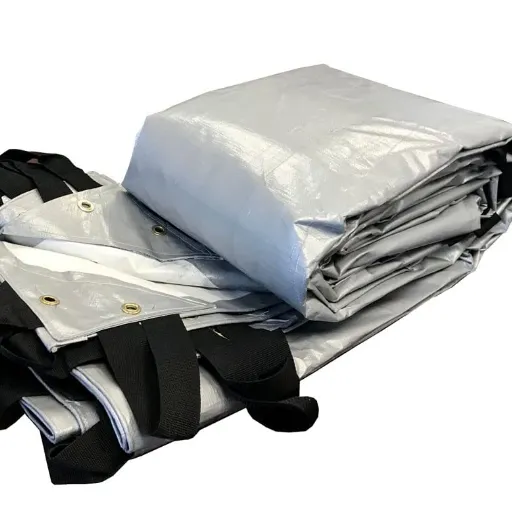
When you find mould, where it sits tells you what went wrong.
| What you see | Likely cause | First fix |
|---|---|---|
| Bottom row damp or mouldy | Ground moisture, no drained base | Pallets, gravel or a raised base; check drainage |
| Wet patches at seams or low spots | Leak, pooled water or a sagging cover | Repair, re-tension and restore the crown |
| Damp underside after a cold night | Condensation | Open the sides, add an air gap, consider breathable canvas |
| Mould through the stack | Baling moisture too high or storage too long | Test moisture at baling; do not seal wet hay |
| Hay hot, musty or smelling burnt | Active heating | Do not climb the stack; call the fire service if it is hot |
Temperature is the safety check. , citing NRAES-18, gives these thresholds: 125°F or lower needs no action; 150°F is the danger zone; 160°F means check every couple of hours; 175°F means hot spots are likely; 190°F means fire is likely; 200°F or higher means imminent. Illinois Extension adds that temperatures usually peak 7-10 days after baling and should be monitored for 30 days. Above 170°F is serious combustion danger.
The fixes are unglamorous: bale at the right moisture and measure it; get bales off the ground; shape the stack to shed water; leave the sides open where airflow is needed; re-tension the cover; patch small holes early. The guide covers PE, PVC and canvas.
Replace the cover when damage is structural: two or more tears longer than 30 cm, five or more scattered holes, or a tear area over a third of the sheet. A cover that cracks when bent has lost its UV protection, and a patch will not restore it.
FAQ
What size hay tarps for round bales do I need?
Measure the stack’s length, width and height, then the path over it from ground to ground. Add at least 2 ft of tuck-under per side and 2 ft of end drop per end. A 3-2-1 pyramid of 4 x 5 bales, 10 bales long, usually needs about a 40 x 48 ft cover.
Can I use a regular tarp for round bales?
A regular PE tarp can work if it is UV-stabilised, sized to the stack and secured properly. A cheap light-duty hay bale tarp usually fails at the eyelets or tears in wind. Check the GSM, UV package and hem first.
Should I use a breathable hay tarp?
Use a breathable cover when condensation is the main risk and the hay is already dry. Canvas is breathable but water-resistant, not waterproof. A sealed PE cover is better when rain is the main risk, provided the sides are open and the base drains. Neither can fix hay baled too wet.
How many round bales will a 30 x 50 tarp cover?
It depends on the stack shape, not a fixed bale count. A 30 x 50 ft round bale hay tarp may suit a long single row or a low two-row stack, but it is usually too narrow for a 3-2-1 pyramid of 4 x 5 bales. Measure the covering path first.
Can I tarp bales at 20% moisture?
Large round bales are usually baled at about 18% moisture. At 20%, the hay is wetter than the target and carries a higher heating and mould risk. If the bales are already made, do not seal them under a waterproof cover. Leave them open to air, monitor temperature and feed them first.
How long will a hay tarp last?
TONGYUAN reports PE life from months at the light end to one to three years or more for heavy, UV-stabilised grades. Canvas is reported at three to seven years. Actual life depends on sun, wind, handling and storage.
Do I need to leave the sides open?
For dry hay, yes, as a default. Open sides let vapour escape and reduce condensation. You can close them on an exposed, rainy site if the hay is dry and the base drains, but watch for mould. For baleage, a hay bale cover is the wrong product; use sealed film.
Conclusion
Hay tarps for round bales are the last decision, not the first. Dry hay at 18% moisture or below can be covered; baleage at 50-60% needs sealed film. Measure the stack, size the cover to the path over it, then choose PE for sealed rain protection or canvas for breathability.
TONGYUAN makes both, cut to your dimensions with the eyelet, hem and corner detail on the order. We do not make a purpose-built breathable hay tarp, and we will tell you when a different product is right.
Send your baling moisture, stack dimensions, bale count and destination port. We will come back with a cover size, fabric recommendation and sample plan. or to start.