
Tarp for Firewood: How to Cover a Woodpile So It Dries
A tarp for firewood is a roof, not a wrapper. Cover the top of the stack, leave the sides open, keep the wood off the ground, and never run the cover from the ridge to the…
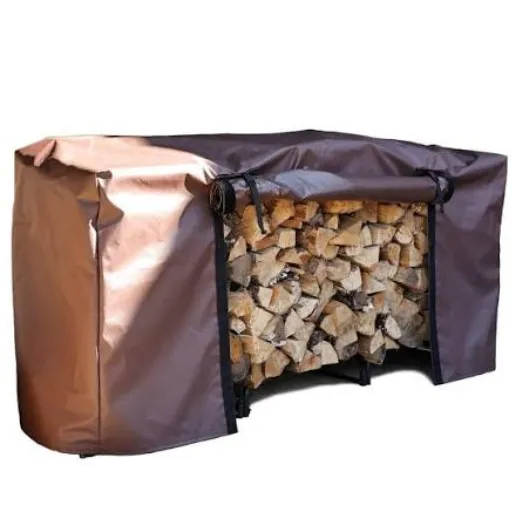
A tarp for firewood is a roof, not a wrapper. Cover the top of the stack, leave the sides open, keep the wood off the ground, and never run the cover from the ridge to the ground. That one rule decides whether your wood dries below 20% moisture or moulds in its outer layer.
The pile that rots is usually the one that was covered most carefully. Someone reads that firewood must stay dry, buys a heavy cover and ties it tight on four sides. By February the wood underneath is wetter than a pile left in the open.
That is not a failure of the tarp. It is a failure of the job the tarp was given.
Key Takeaways
- A tarp on firewood is a roof. Cover the top, leave the sides open, keep the stack off the ground.
- In a controlled comparison, a fully wrapped pile dried no faster than a top-covered pile, and mould grew only inside the wrap.
- Size the cover from the stack: width equals stack depth plus twice the side drop, length equals stack length plus twice the end drop.
- PE at 120-180 GSM with UV stabilisation is the practical roof. Canvas at 12-18 oz/yd² is breathable but water-resistant, not waterproof.
- A cover keeps dry wood dry. It does not dry wet wood, and a heavier tarp will not rescue a damp stack.
If you already know your stack size, and we will check the cover size before you price the job.
What a Tarp for Firewood Can and Cannot Do
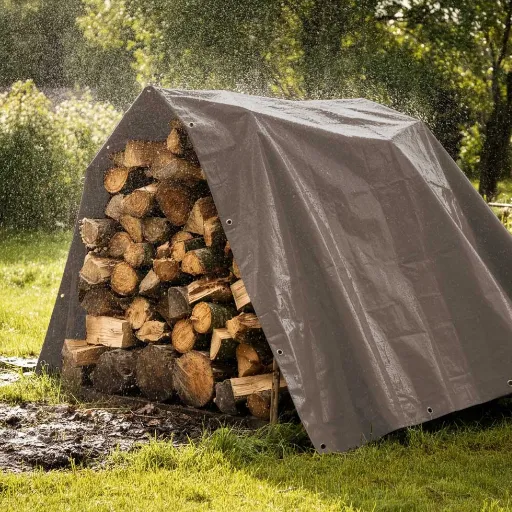
A woodpile outdoors faces rain, snow, dew and ground moisture. A cover for firewood deals with the first three, and only on the surface it covers.
It keeps precipitation off the top. Split wood takes water in slowly, mostly through the cut ends. Every hour of rain you block is an hour the wood spends drying. A of interior Alaska conditions calculated that a 5 ft stack collects about 110 gallons of water per cord between June and September, more than half the water a cord loses on the way from green to 15% moisture.
It does not dry wood. Drying is evaporation, and evaporation needs air moving across wet surfaces. A cover that blocks rain and also blocks air is a net loss.
It does not shorten seasoning. gives 6 to 8 months as a normal window for split softwood, and hardwood takes longer.
Picture a household in Vermont with four cords stacked against a shed wall. In September the owner wraps the whole stack in a dark 100 GSM tarp, top to ground, and weights the edges with bricks. By February the outer inch of every split is damp and streaked with grey mould, and the fire smoulders.
The fix costs nothing: move the wood off the wall, stand it on pallets, and drape the same tarp over the top only. The example is illustrative, but the mechanism behind it has been measured. The same mistake runs through most firewood tarps sold at retail: the sheet is fine, and the way it is fitted is the problem.
Cover the Top, Not the Stack
The top-only rule sounds like folklore. It is not, and the test result is more useful than the rule.
In 1986 the US Forest Service published a pilot study by Sampson and Gasbarro on drying paper birch in interior Alaska. Three stacks were built. One was top-covered with roofing paper as the control. The other two had the top and all four sides enclosed in 6 mil polyethylene, with air inlets at the bottom and vents at the top, to form simple solar kilns.
After 120 days, the wood inside the wrapped piles was no drier than the wood under the top cover. Moisture started between 73% and 108% on a dry-weight basis and finished between 28% and 38% in both setups, despite temperatures 5°F to 10°F higher inside the wraps. Mould developed on the ends of pieces inside the wrapped piles. The top-covered control had none.
The authors drew a blunt conclusion: a waterproof top covering is about the most that can be economically justified. A later Alaska study from the Cold Climate Housing Research Center points the same way. Split birch and spruce stored in a wood shed or left uncovered cured in about 1.5 months over a summer. The same wood took about three months.
Why a wrapped pile fails. A wrap removes the through-draught. Vapour rising off green wood stays put, meets the cooler underside of the cover, condenses, and runs back down. The pile sits close to saturation under what looks like a perfectly dry roof.
That is why a waterproof tarp for firewood is not automatically the right purchase: waterproofing describes the sheet, not what the sheet does to the air around the wood. Extension services are not unanimous either. One Ask Extension answer to a homeowner with mouldy wood noted that resources disagree about covering at all, and recommended a lean-to or open shed as the safer option.
How much should hang over the side. Enough drop to clear the drip line, and not enough to reach the ground. Allow 8-18 in (200-450 mm) per side. Once the eaves touch the ground, the roof has become a wall.
What Size Tarp for Firewood Do You Need?
Sizing is arithmetic, not judgement. A fixed firewood cover only suits one stack shape, and it is unlikely to be yours.
A cord is a volume, 128 cubic feet, usually 8 ft by 4 ft by 4 ft. Two one-cord stacks can need completely different covers, because one may be a single row 18 in deep and the other a block 4 ft deep. Measure the finished stack: length, depth and highest point.
- Cover width = stack depth + (2 × side drop)
- Cover length = stack length + (2 × end drop)
- Ridge allowance = add about 10% to the width if the cover will sit on a peak so air passes underneath
Do not add tuck-under. That is the hay-tarp habit, and it is the wrong habit here. A tucked edge is a sealed edge.
| Worked example | Stack size | Side drop | Cover width | Cover length | Size to order |
|---|---|---|---|---|---|
| Single row, sheltered | 16 ft long, 2 ft deep, 4 ft high | 12 in | 2 + 2 = 4 ft | 16 + 2 = 18 ft | 4 × 18 ft |
| Deep block, exposed | 24 ft long, 4 ft deep, 6 ft high | 18 in | 4 + 3 = 7 ft, +10% ridge = 7.7 ft | 24 + 3 = 27 ft | 8 × 27 ft |
The first is a garden stack that a stock 4 × 18 ft tarp for firewood will fit. The second is not, which is the normal case.
The same arithmetic runs in our if you want to check a number before sending it.
Most stacks are not tidy. A 30 ft cover on a 21 ft stack hangs in folds that catch wind and pool water, which is the start of the next failure rather than a safety margin. Cut-to-size is the normal answer above a garden pile, and it is how TONGYUAN supplies both PE and canvas. When comparing tarps for firewood, check the finished dimensions, because a listed stock size is often the cut size.
Choosing a Tarp for Firewood: PE or Breathable Canvas?
Two fabrics cover this job and they are not interchangeable: a sealed sheet, and a woven cloth that passes vapour.
PE is a woven HDPE base with an LDPE coating on both sides. It is waterproof as a sheet, which is what a roof needs to be, and it is the cheapest way to buy area. TONGYUAN supplies with tensile quoted by grade in N/5cm and a UV stabiliser from 0.3% to 3%. Published service bands run from months at 60-100 GSM, through 6-12 months at 120-180 GSM, to 1-3 years and more outdoors at 200-300 GSM.
Canvas is a woven cotton duck proofed with wax or paraffin. It passes vapour, so condensation under the cover is much reduced, and it sheds light rain. It is not waterproof: sustained rain wets it through, and pooled water on a slack canvas finds its way in. TONGYUAN supplies , roughly 410-610 GSM, with a mildew inhibitor standard for export. It is heavier and dearer per square metre than PE, and earns that back only where vapour movement is the point. Our published position on this job is short: canvas top cover, open sides. The explains the mechanism in full.
| Question | PE tarpaulin | Cotton canvas |
|---|---|---|
| Main risk on site | Driving rain and snow | Condensation and slow drying |
| Water resistance | Waterproof as a sheet | Water-resistant, wets through |
| Vapour movement | None, it is a coated sheet | High, the weave passes vapour |
| Weight to handle | Lighter for the same area | Heavier, especially wet |
| Cost per m² | Lower | Higher |
A dry stack on a windy, rainy site wants the sealed sheet. A damp, windless site where the wood is still curing favours the breathable cover.
| Specification line | What to specify | TONGYUAN range |
|---|---|---|
| Material | PE or cotton canvas | Both |
| Weight | GSM for PE, oz/yd² for canvas | PE 60-300 GSM; canvas 12-18 oz/yd² |
| UV stabiliser | Percentage by grade | 0.3%-3% |
| Finished size | Width by length, finished not cut | Custom |
| Eyelet spacing | 30-45 cm high wind, 45-60 cm general | Specified per order |
| Hem and corners | Rope-reinforced hem, corner patches | Both available |
| Colour and packing | Per order; destination port for freight | Per order |
Send those seven lines and a supplier can quote without guessing. before committing to a container.
GSM, UV and Finishing for a Firewood Tarp
A cover fails at its edges or its fabric, and the specification decides which. This is the part a retail listing cannot help you with.
GSM. For a firewood tarp that stays out for one heating season, 120-180 GSM PE is the practical band. It has enough body to resist flapping and enough tensile to hold at the eyelets. Go to 200-300 GSM when the cover is large, the site exposed, or you want more than one season. Weight is not the whole story: two covers both sold as 180 GSM can differ if one uses a heavier weave and a lighter coat. Compare tensile in N/5cm alongside weight, as the advises.
UV stabilisation. Sun destroys PE faster than wind does, from the outside in. Ask for the percentage, not the word “UV resistant”. TONGYUAN quotes 0.3% to 3% by grade, and in high sun that figure matters more than an extra 20 GSM.
Eyelets and hems. Roughly 80% of tarpaulin field failures start at the eyelets and hems rather than in the fabric panel, according to our finishing team. Space eyelets at 30-45 cm for high wind, 45-60 cm for general duty, and up to 1 m only for a sheltered stack. Keep them at least 15 mm inside the edge or they tear out under load.
If you buy one upgrade, buy the rope-reinforced hem: our page calls it the most effective single upgrade, more so than a higher GSM, because it spreads load along the whole edge instead of concentrating it at each hole.
What to put on the purchase order. Use the table above. Material; GSM for PE or oz/yd² for canvas; UV percentage; finished size, width by length; eyelet spacing, material and offset; hem construction and corner reinforcement; colour, packing and destination port.
How to Stack and Cover Firewood
The cover is the last step. Everything before it decides whether a tarp for firewood has a chance.
Site and base. Pick level, well-drained ground with air on at least two sides. Stack the wood off the ground and not directly against a structure, as puts it, because ground moisture wicks upward and a wall blocks airflow on one face. A pallet, timber bearers or spaced blocks all work. The recommends a base that keeps wood off the ground to reduce pests and moisture.
Shape. A single row dries fastest, because both faces see air. Where space forces a block, stack log-cabin style so the layers cross and air moves through the stack. Cap the height at something you would want to stand next to in a wind.
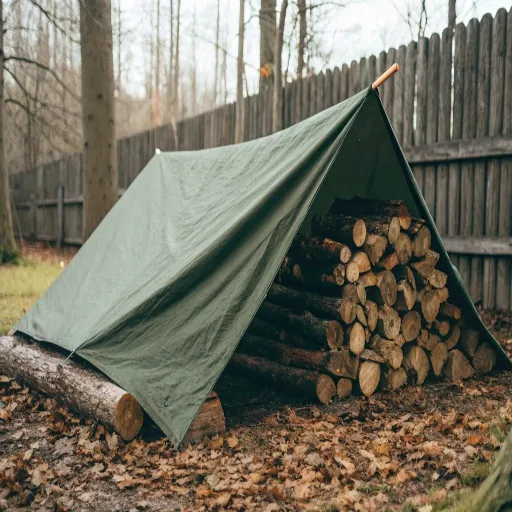
The air gap. A ridge pole down the centre, or two poles across the top, lifts the fabric so air moves under it and condensation has somewhere to go other than the wood. It also slopes the cover so water runs off rather than pooling, which is the EPA’s point about a roof with a generous overhang.
Install, secure, inspect. Centre the cover before tensioning anything, pull it to an even drop on both sides, then fix the edges with rope or bungee through the eyelets, anchored to the rack or to ground stakes. Never rely on gravity alone on an exposed site, and never nail through the fabric panel. After every gale, check the eyelets for elongation and the hem for tearing. After snow, clear the top with a soft broom, and never climb a stack to do it. Our guide to covers anchors and tensioning in more depth.
Two illustrative examples. A smallholding stacks on pallets under a 180 GSM cover with an 18 in drop and a ridge pole holding the fabric 8 in above the wood. By early October a meter on a freshly split face reads about 17%.
A merchant buys light 70 GSM covers because they are cheap per piece. The first autumn gale tears the eyelets out of three in one night, and the replacement order specifies a rope-reinforced hem.
When to Cover, When to Uncover, and When to Skip the Tarp
The job changes between the drying season and the heating season, and the cover should change with it.
Through spring and summer the priority is air. Uncovered wood dries fastest, but it is also at the mercy of the weather and can be wet again by autumn. The compromise most growers settle on is a top cover from early in the season: rain off, air through. What does not work is sealing it in June.
Through autumn and winter the priority flips to keeping water off wood that is already dry. The roof stays on, the sides stay open, and snow comes off the top rather than being packed down on it.
Reading the stack. Check the wood, not the cover. Grey or white fuzz on the ends and a musty smell mean too little air: open the sides, check the base, and confirm the cover is not reaching the ground. A wet outer layer under an intact cover means condensate or water running back under an overlong drop. Splits that feel cold and heavy, or a dull thud when knocked together, are still wet.
Below 20% moisture is the standard for burning, and it is the number both WVU and Oregon State Extension use. Timing matters as much as the cover: in the Alaska study, wood harvested in autumn did not cure by spring under any method, and some samples gained moisture under a tarp over winter.
When a shed beats a tarp. A tarp for firewood is the right buy for a stack you rebuild each year, for stock you need to move, and for a budget that will not stretch to a structure. A shed, lean-to or sheet of metal roofing is better when the stack is permanent, the site wet and windless, or the wood handled often enough that a cover becomes a nuisance. We make covers, and we will still tell you that a roof over a permanent stack outperforms a tarp over the same stack.
FAQ
Should I cover my firewood with a tarp?
Yes, if you cover the top only and leave the sides open. A tarp as a roof keeps rain and snow off wood that is drying or already dry. A tarp wrapped around the whole stack removes the airflow drying depends on, and the wood under it can end up wetter than an open pile.
What is the best tarp for firewood?
A UV-stabilised PE tarpaulin of 120-180 GSM, cut to the size of your stack, with a rope-reinforced hem and eyelets at 45-60 cm. That gives you a rain roof that survives a season of wind. If condensation is your main problem and the site is sheltered, a breathable canvas cover is the better choice.
Can I use a regular tarp for firewood?
A regular poly tarp works as a top cover if it is UV-stabilised and sized properly. The usual failures are a light grade that goes brittle in one summer, eyelets that tear out in wind, and a cover so much larger than the stack that it sags and pools water.
Is a firewood tarp cover different from a woodpile tarp?
They describe the same thing: a sheet over stacked wood. What varies is the fabric, weight and edge detail, not the name. A fitted log rack cover is the different product, shaped in three dimensions for a steel rack.
What size tarp do I need for a cord of firewood?
A cord is a volume, not a shape, so there is no single answer. Measure the built stack and add the drop: cover width equals depth plus twice the side drop, and cover length equals length plus twice the end drop. A single row 16 ft long and 2 ft deep usually takes about a 4 × 18 ft cover.
Will firewood dry under a tarp?
Only if the sides are open. In the Forest Service comparison, wood in a fully wrapped pile dried no faster than wood under a top cover after 120 days, and mould grew only inside the wrap.
Do tarps burn?
Polyethylene and cotton canvas both burn, and neither is heat-resistant by default. Keep every cover clear of flues, stovepipes, ash pits and ember sources, and never store firewood or a cover against a chimney.
How long will a firewood tarp last?
TONGYUAN reports PE service bands from months at 60-100 GSM, through 6-12 months at 120-180 GSM, to 1-3 years and more outdoors at 200-300 GSM. Canvas is heavier and longer-lived but wets through in sustained rain.
Conclusion
A tarp for firewood does one job well, and the rest follows from it. Cover the top, leave the sides open, keep the stack off the ground, and size the cover to the stack you actually built.
Then specify it properly. PE at 120-180 GSM with a stated UV percentage and a rope-reinforced hem is the rain roof for most stacks. Canvas at 12-18 oz/yd² is the right answer where vapour has to keep moving. Neither will dry wet wood.
Covers need care as well as purchase: between seasons gets a second winter out of it.
TONGYUAN makes both fabrics, cut to your dimensions with the eyelet, hem and corner detail you specify. Tell us the stack size, the exposure and the destination port, and we will come back with a cover size, a fabric recommendation and a sample plan. or to start.