
What GSM Tarpaulin Do I Need? PE & PVC Selection Guide
For most applications, the answer to "what GSM tarpaulin do I need" is straightforward: 60–100 GSM for light equipment and short-term covering, 120–180 GSM for general agricultural and storage use, and 200–300 GSM for truck covers,…
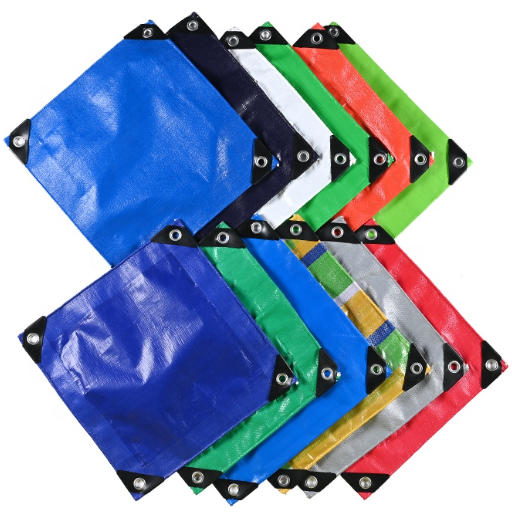
For most applications, the answer to “what GSM tarpaulin do I need” is straightforward: 60–100 GSM for light equipment and short-term covering, 120–180 GSM for general agricultural and storage use, and 200–300 GSM for truck covers, construction, and long-term outdoor exposure. Above 300 GSM, you’re usually specifying PVC rather than PE.
The GSM figure is the number buyers most often overpay for. Upgrading from 180 GSM to 250 GSM without checking the UV treatment buys weight, not necessarily service life. Get the specification right, and you save money; get it wrong, and you pay twice, once at the container and once when the cover fails early.
You are right to start with GSM. It’s the industry’s shorthand for tarpaulin grade. This guide shows you how to read it, match it to the job, and check that what arrives matches what you ordered.
Key Takeaways
- GSM (grams per square metre) measures total fabric weight, including coating. It is a proxy for strength, not a direct measure of it.
- PE tarpaulin runs 60–300 GSM; PVC tarpaulin starts around 300 GSM.
- UV stabilisation affects service life more than GSM does in high-sun markets.
- Tensile strength in N/5cm is the number to compare between suppliers, because GSM can be quoted loosely.
- Weigh a sample before ordering a container. A 200 GSM tarp should weigh about 200 g per square metre.
Tell us the application and the service life you need. We will recommend a grade and send a sample so you can check it before committing to a container.
What GSM Actually Means
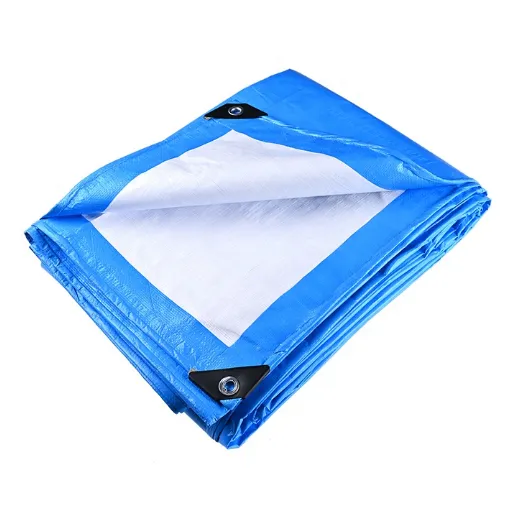
GSM stands for grams per square metre. It is the combined weight of the woven base fabric and the coating on both sides.
It’s genuinely useful shorthand for grade, but it’s a weight, not a measurement of strength. Two tarpaulins both sold as 200 GSM can perform differently if one uses a heavier weave with a lighter coating and the other the reverse. The weave carries tensile strength; the coating carries waterproofing and UV resistance.
That’s why the specification to compare between suppliers is not GSM alone. Ask for tensile strength in N/5cm alongside it.
GSM Is a Weight, Not a Thickness
Buyers often use “GSM” and “thickness” as if they were the same thing. They are not. GSM is weight per square metre. Thickness is measured in millimetres, and it is the unit used for PVC fabric, not for PE.
A heavier GSM usually means a heavier, denser fabric. But two covers can weigh the same and measure differently depending on how the weave and coating are balanced. When you ask a supplier for thickness, and they give you GSM, that is the signal to ask for the actual millimetre figure or the tensile value.
GSM Is a Proxy for Strength, Not the Strength
The figure that actually tells you what a cover will hold is tensile strength, quoted in N/5cm. In our PE range, that figure runs from roughly 400 N/5cm at 120 GSM toward 650 N/5cm at 180 GSM in company testing.
GSM and tensile move together, which is why GSM is a useful starting point. But they are not the same measurement, and a supplier who quotes only GSM is leaving the number that matters most off the table.
GSM to oz/yd²: The Imperial Equivalent
If you work in imperial units, GSM converts to ounces per square yard by multiplying by 0.0295. A 200 GSM tarpaulin is about 5.9 oz/yd². Our GSM ↔ oz/yd² calculator does the conversion both ways.
The GSM Bands: PE and PVC Ranges
Here is the full picture across the materials we manufacture.
| GSM Range | Grade | Typical Tensile (PE) | Common Applications | Expected Outdoor Life |
|---|---|---|---|---|
| 60–100 | Light duty | From ~250 N/5cm | Equipment covers, light yard work, short-term covering, dust sheets | Months to one season |
| 120–180 | Medium duty | ~400–650 N/5cm | Hay, grain, silage, general outdoor storage, construction materials | One to three years |
| 200–300 | Heavy duty | Toward 650 N/5cm and above | Truck and cargo covers, construction enclosure, long-term exposure | Three years and beyond with UV stabilisation |
| 300+ (PVC) | Coated fabric | Higher, by grade | Truck covers, tents and marquees, architectural membrane, industrial covers | 2–10+ years by grade |
Figures are company-reported. Tensile values are indicative and vary by construction. Always confirm against the batch test report for the grade you are buying.
Two materials sit in this table, and the split matters. PE covers 60–300 GSM and is the workhorse for agriculture, storage and general covering. PVC starts around 300 GSM and is the choice where abrasion, tear resistance and long service life decide the purchase. See our PE tarpaulin range and PVC tarpaulin range for the full specification of each.
Not sure which band fits? Tell us the application, the surface to be covered, and the service life you expect. We will return a grade recommendation and a sample plan.
What GSM Tarpaulin Do I Need by Application?
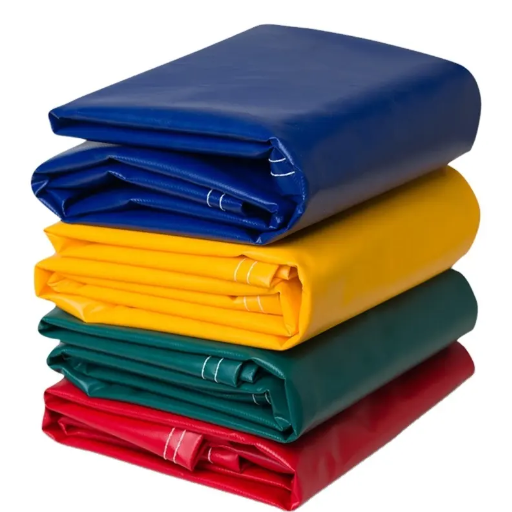
The band you need follows from what the cover must survive. Here is the quick reference, then the reasoning for each job.
| Application | Recommended GSM | Material |
|---|---|---|
| Light yard, short-term covering | 60–100 GSM | PE |
| Equipment and machinery covers | 200–250 GSM (or 450–500 GSM) | PE (or PVC) |
| Hay, grain and silage storage | 150–250 GSM | PE, UV-stabilised |
| Construction scaffolding, enclosure | 200–300 GSM (or PVC if flame-retardant) | PE (or PVC) |
| Truck covers, routine or protected | 200–300 GSM | PE |
| Truck covers, daily exposed routes | 650–900 GSM | PVC |
| Tents, marquees and awnings | 500 GSM and up | PVC |
| Emergency and relief supply | 180–250 GSM | PE |
Truck and Cargo Covers
200–300 GSM PE for routine covering, or PVC from 300 GSM for daily use on exposed routes. Heavy-duty truck covers abrade and flex constantly, which is where PVC’s tear and abrasion resistance earns its higher price. A daily flatbed cover is usually specified at 650–900 GSM PVC; a covered trailer runs on 200–300 GSM PE.
Hay, Grain and Silage Storage
150–250 GSM PE with UV stabilisation. The stabiliser matters as much as the weight here. These covers sit in direct sun for months and fail due to UV degradation more often than tearing.
Construction Scaffolding and Site Enclosure
200–300 GSM PE, or PVC where flame retardancy is required. Check local site regulations before specifying, since flame-retardant requirements vary by market.
Equipment and Machinery Covers
200–250 GSM PE or 450–500 GSM PVC. The deciding factor is usually whether the cover is removed and refitted regularly. Repeated handling favours PVC.
Tents, Marquees and Awnings
PVC from 500 GSM. These fabrics are tensioned and handled repeatedly, and PE does not hold up to either.
Emergency and Relief Supply
180–250 GSM PE. Standardised, easily packed and handled, with batch documentation available for institutional procurement.
Light Yard and Short-Term Covering
60–100 GSM PE. Don’t expect more than a season outdoors, and don’t specify it for anything that must survive a windy site.
For the strength-first version of this decision, our heavy-duty tarpaulin guide sets out the selection criteria without assuming a material.
The Trade-Off: What a Higher GSM Costs You
Higher GSM is not automatically better. It costs more per square metre and weighs more to handle, and in high-sun markets it can still fail early if the UV treatment is missing.
A distributor supplying construction sites in the Gulf once upgraded an order from 180 GSM to 250 GSM to be safe, without changing the UV treatment. Eight months later the covers had degraded in the sun, and the upgrade had bought extra weight and cost but almost no extra life. The stabiliser package, not the extra 70 GSM, was the variable that mattered.
Ask two questions instead of one:
- What GSM is this?
- What UV treatment does it carry, and is it tested?
If the supplier can’t answer the second, the first number tells you less than you think.
The same logic works in reverse. A transport buyer once specified 900 GSM PVC for covered trailers that ran protected from the sun and never saw abrasion. The covers lasted years, but so would 450 GSM PVC at a fraction of the weight and cost. Over-specifying is a real cost, and it shows up in every container.
Neither grade is better. The grade that fails is the one chosen for the wrong job.
Quoted vs Measured GSM: Weigh a Sample
GSM is easy to state and hard for a buyer to verify at the point of purchase. Which is why the practical check is a set of scales.
An importer in East Africa weighed a sample of a cover sold as 200 GSM before placing a repeat order. It came in at about 165 grams per square metre, a 17% shortfall against the label. The supplier had quoted a grade the fabric did not meet. A few minutes with a set of scales saved a container’s worth of disputes.
Weigh a sample before ordering a container. A 200 GSM tarpaulin should weigh approximately 200 grams per square metre. A 6 m × 4 m cover in 200 GSM therefore approximates 4.8 kg before eyelets and hem reinforcement. A meaningful shortfall means the grade is not what was quoted.
We say this knowing it applies to us too. Our PE tarpaulins run from 60 to 300 GSM with in-line GSM checks as part of a 26-stage quality control system, and batch test reports are available on request. If a buyer weighs our product on arrival, we want the number to match. That is the whole point of documenting it.
Request a batch test report before you commit to a container. It is the cheapest verification available, and it is the difference between a specification and a claim.
How to Read a Tarpaulin Specification
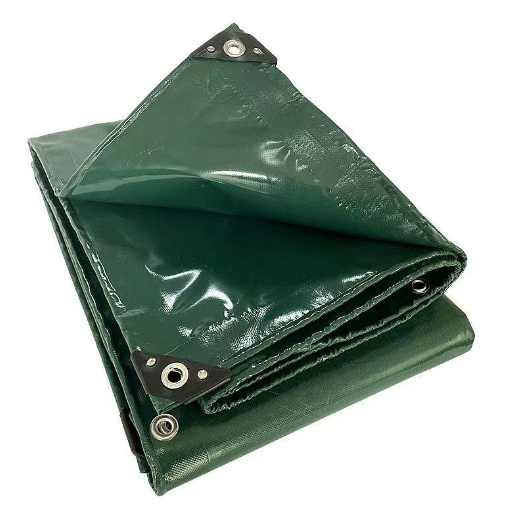
When comparing quotes, these are the fields that matter.
| Field | Why It Matters |
|---|---|
| GSM | Weight basis for the grade. The starting point, not the whole picture. |
| Tensile strength (N/5cm) | The measurable strength figure. Compare it like for like. |
| UV treatment | Determines service life in the sun more than GSM does. |
| Weave construction | Affects tensile strength and tear resistance at a given GSM. |
| Coating method | Knife coating or lamination. Affects consistency of coating weight. |
| Eyelet spacing and reinforcement | Where most covers fail first. |
| Dimensions and tolerances | A cover 200 mm short is scrap. |
| Batch test report | Whether the claimed numbers were actually measured. |
If a supplier cannot provide most of this table, the quote is not yet comparable.
How GSM Is Tested and Batch Consistency
The question behind every GSM decision is the same: will the second container match the first?
GSM is checked in line during production, alongside tensile strength, UV performance, and dimensional accuracy. A batch test report ships with the order on request, and independent BV or SGS inspection can be arranged before the container is sealed. Test methods follow ASTM D751 and ISO 13934-1 where applicable.
That’s the difference between a manufacturer and a trader. We run the checks ourselves because we run the machines.
Frequently Asked Questions
What does GSM mean in tarpaulin?
GSM stands for grams per square metre. It is the combined weight of the woven base fabric and the coating on both sides, and it is the industry’s shorthand for tarpaulin grade.
What GSM tarpaulin do I need for a truck cover?
200–300 GSM PE for routine covering, or PVC from 300 GSM for daily use on exposed routes. A daily flatbed cover is usually 650–900 GSM PVC; a covered trailer runs on 200–300 GSM PE.
Is higher GSM tarpaulin always stronger?
Not necessarily. Higher GSM means more weight and higher cost. If the tarpaulin is not UV-stabilised, a heavier cover can still fail in one season under direct sun. Match GSM to the application and specify the treatment as well.
What GSM is a heavy-duty tarpaulin?
In PE, 200–300 GSM is generally treated as heavy-duty. In PVC, grades from 650 GSM upward are used for heavy-duty and permanent installations. See our heavy-duty tarpaulin guide for the selection criteria.
How do I convert GSM to ounces per square yard?
Multiply GSM by 0.0295 to get oz/yd². A 200 GSM tarpaulin is about 5.9 oz/yd². Our GSM ↔ oz/yd² calculator does it both ways.
How can I check the GSM of a tarpaulin?
Weigh it. A 200 GSM tarpaulin should weigh about 200 grams per square metre of fabric. Compare the measured weight against the quoted grade before accepting a bulk order.
What is the MOQ and lead time for tarpaulin?
PE tarpaulin starts around 1,000 kg or one 20GP container; PVC tarpaulin around 3,000 kg. Trial-order terms are negotiable. Production runs 15–25 days from order confirmation, and free samples ship in 3–5 days.